The Florence Field Guide 2026 Edition
Read the Full Guide | Download PDF
Uffizi · Accademia

Florence in One Day

Two museums. Every masterpiece that matters. Four hours of viewing — and a plan that actually works.

90
Min · Accademia
2.5
Hrs · Uffizi
25+
Masterpieces
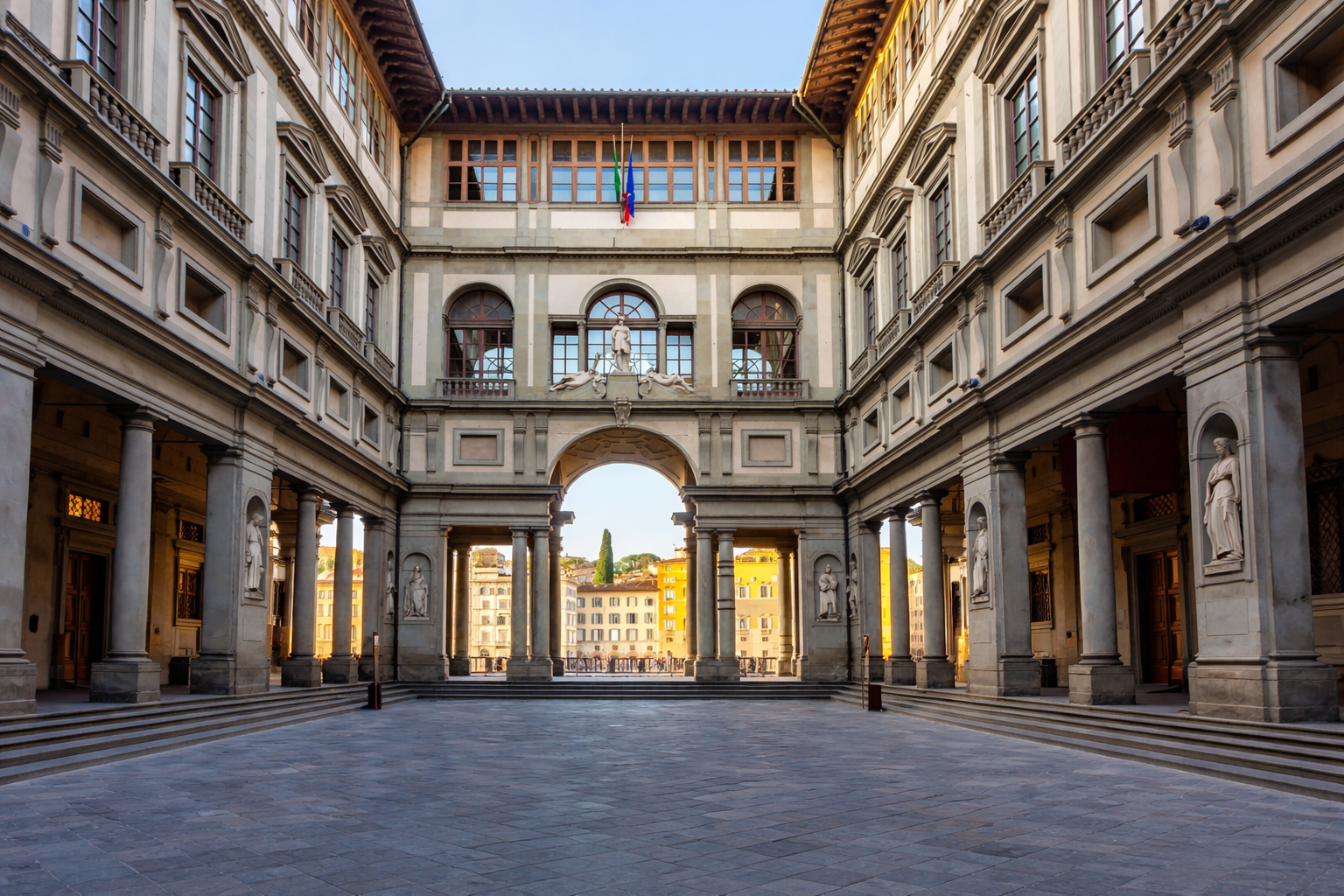
The Uffizi Gallery in Florence at dawn, the Arno side of the Vasari corridor lit by soft light.

Short on time in Florence? This guide walks you through both museums in a single day — hitting every highlight and skipping the filler.

You’ll cover the Accademia and the Uffizi in about four hours of actual viewing, following a route shaped by light, crowds, and the natural rhythm of masterpieces.

4 hrs
Viewing Time
2 sites
Museums Covered
€45
+ Fees · Total Tickets

Contents

  1. 01

    Plan Your Day

    Schedule, tickets, practical tips

    Part 01 →
  2. 02

    Accademia Gallery

    Michelangelo’s David and six essential rooms

    Part 02 →
  3. 03

    Uffizi Gallery

    Ten rooms, from Giotto to Artemisia

    Part 03 →
  4. 04

    Quick-Reference Routes

    At-a-glance route cards for both museums

    Part 04 →
  5. 05

    Five Insider Tips

    Secrets from seasoned Florence hands

    Part 05 →

Part One

01

Plan Your Day

A Florence day that works starts with a schedule — one that respects crowd patterns, natural light, and the fact that you’re human and will need lunch.

8:15
AM · Opening Bell
4:30
PM · Final Room
3
Stops Between
Part One · Plan Your DayThe Schedule

The Schedule

Start early at the Accademia, walk the historic center at mid-morning, and save the Uffizi for the calmer afternoon pacing.

  • 8:15 AMEnter the Accademia at opening
  • 9:45 AMWalk to the historic center (15 min)
  • 10:00 AM – 1:00 PMDuomo, Piazza della Signoria, lunch
  • 1:00 – 4:30 PMUffizi Gallery

Why This Order?

The Accademia is small and David is best seen without crowds. The Uffizi needs more time and benefits from afternoon pacing.

Tickets & Costs

Accademia

€16

+ €4 online booking fee

Uffizi Gallery

€25

+ €4 online booking fee

Book at least one week ahead via the official sites or authorized resellers (GetYourGuide, Tiqets). Bring photo ID — Uffizi tickets are issued in your name.

Plan Your Day · The Schedule04
Part One · Plan Your DayQuick Tips

Quick Tips

Five small choices that separate a smooth museum day from a frustrated one.

  1. 01

    Never visit on the first Sunday of the month.

    Free admission means chaos. Every local and every backpacker shows up.

  2. 02

    Best days: Wednesday to Friday.

    Weekends are packed; Mondays are tricky because the Uffizi is closed.

  3. 03

    Wear comfortable shoes.

    Marble floors, long corridors, and the Florentine cobblestones in between.

  4. 04

    Travel light.

    Large bags aren’t allowed — expect to cloak them at the entrance.

  5. 05

    Flash-free photos are OK.

    Turn the flash off on your phone before you step in.

Good to Know

Download any audio tour before you enter — Wi-Fi inside both museums is unreliable, and you don’t want to discover that at the foot of David.

Plan Your Day · Quick Tips05

Part Two

02

The Accademia Gallery

The Accademia is compact and mostly linear. Michelangelo is the main event — but a handful of other works earn your attention on the way.

90
Minutes On Foot
6
Essential Rooms
5.17m
Height of David
Part Two · The Accademia90 Minutes
0115 Minutes

Hall of the Colossus

Rape of the Sabine Women — Giambologna

Center of the room (plaster model)

A full-size study for the marble version in Loggia dei Lanzi. Three figures spiral upward in one continuous motion.

Why See ItThe first major sculpture designed to be viewed from every angle. Walk all the way around it.

Madonna of the Sea — Botticelli

Wall panel, easy to miss

Small, intimate painting of the Virgin holding a pomegranate against a moody seascape.

Why See ItA rare quiet Botticelli most visitors walk past.

Cassone Adimari — Lo Scheggia

Adjacent 15th-century room

A painted wedding chest showing a Renaissance marriage outside the Florence Baptistery.

Why See ItA rare window into everyday Florentine life around 1450.

TipThis hall is rarely crowded — most visitors rush straight to David. Linger here while the corridor ahead empties out.
0215 Minutes

Hall of the Prisoners

The Four Prisoners (Slaves) & St. Matthew — Michelangelo

Lining the corridor to David

Unfinished figures straining to emerge from raw marble. Carved 1520–1534 for Pope Julius II’s tomb.

Why See ItArguably more moving than David. You can see Michelangelo’s chisel marks and his method of “freeing” figures from stone.

Venus and Cupid — Pontormo (from a Michelangelo cartoon)

Corridor wall

Recently restored, revealing a luminous nude once hidden under painted drapery.

Why See ItA direct collaboration with Michelangelo’s own design.

TipSlow down here. The corridor is wide and crowds thin out.
0320 Minutes

The Tribune — Michelangelo’s David

David — Michelangelo

Domed apse at the end of the corridor

5.17 meters of Carrara marble, carved 1501–1504 from a block two other sculptors had abandoned.

Why See ItThe defining sculpture of the Renaissance. Captures the moment before David fights Goliath — pure psychological tension.

Insider TipCircle the statue completely. The 45° angle reveals the bulging neck vein and back muscles. At 8:15 AM opening, you may have 5–10 minutes nearly alone with it.
0410 Minutes

Gipsoteca Bartolini

Turn left from David

Over 400 plaster casts from a 19th-century sculptor’s studio, with powder-blue walls and soft lighting.

Why See ItAtmospheric, eerie, and almost always empty. The most peaceful room in the museum.

TipFive to ten minutes is plenty.
0510 Minutes

Florentine Gothic Rooms

Tree of Life — Pacino di Bonaguida

Sala di Pacino

Allegorical Crucifixion painted as a tree with 48 miniature scenes of salvation. Painted around 1305.

Why See ItA masterclass in medieval storytelling — and barely any foot traffic.

0610 Minutes (Optional)

Museum of Musical Instruments

Side wing near the entrance

Three Stradivarius instruments made for the Medici around 1690, plus a spinet by Cristofori (inventor of the piano) and a marble psaltery.

Why See ItQuietest room in the museum. Worth ten minutes if you have time.

Short On Time? · 60-Minute Route

Skip the Musical Instruments, Gipsoteca, and Gothic rooms. Go straight: Hall of the Colossus → Prisoners → David → exit.

The Accademia · Remaining Rooms09

Part Three

03

The Uffizi Gallery

Three floors in a U-shape. Start on the second floor for medieval through High Renaissance, then descend to the first floor for Titian and Caravaggio.

2.5h
Suggested Visit
10
Essential Rooms
500+
Plants In Primavera
Part Three · The UffiziRooms 2 – 3

The Uffizi Gallery

Start on the second floor (top) for medieval through High Renaissance, then descend to the first floor for Titian and Caravaggio.

2026 Update

Botticelli’s major works — including Birth of Venus and Primavera — have been temporarily moved to Room A9 on the second floor during renovation. Grab the free map at the entrance to confirm current locations.

01Room 2 · 5 Minutes

Birth of the Renaissance

Three altarpieces hanging side by side tell the whole story of Western art’s transformation.

  • Santa Trinita Maestà — Cimabue (c. 1280) — flat, golden, Byzantine
  • Rucellai Madonna — Duccio (1285) — early modeling and emotion
  • Ognissanti Madonna — Giotto (c. 1310) — solid, weighted, revolutionary

Why See ItNo other museum shows the birth of Renaissance painting this clearly.

TipFive minutes. Read the plaques — context matters here.
02Room 3 · 3 Minutes

Annunciation with Saints

Simone Martini & Lippo Memmi (1333)

Shimmering gold leaf on luminous blue. Mary recoils from Gabriel, body twisting away.

Why See ItRare emotional frankness for Gothic art. Most visitors walk right past.

TipTwo to three minutes. An underrated gem.
03Room 7 · 3 Minutes

Adoration of the Magi

Gentile da Fabriano (1423)

The pinnacle of International Gothic: gold leaf, brocades, exotic animals, royal pageantry.

Why See ItMedieval extravagance at its peak, just before the Renaissance swept it away.

04Room 8 · 5 Minutes

Duke and Duchess of Urbino

Piero della Francesca (c. 1465)

Strict-profile portraits of Federico da Montefeltro (with his famous broken nose) and Battista Sforza, against detailed landscape backgrounds.

Why See ItAmong the earliest accurate landscapes in Western art. Stand close to see the details.

TipFive minutes. Usually calm.
05Room A9 (Temporary) · 20 Minutes

Botticelli

Birth of Venus (c. 1485) & Primavera (c. 1482) — Botticelli

Birth of Venus: the goddess arriving on a scallop shell. One of the first large-scale female nudes since antiquity.
Primavera: an allegory of spring featuring over 500 identifiable plant species. Still debated by scholars.

Why See ItThe most iconic paintings of the Florentine Renaissance — together.

Insider TipAllow 20 minutes. Stand back for the full composition, then move close for details. Early afternoon is calmer than late morning.
06Room 35 · 10 Minutes

Leonardo da Vinci

Annunciation (1472–75)

Painted at age 20 while apprenticed to Verrocchio. Wings based on real bird anatomy; misty sfumato landscape.

Why See ItYou can already see the mind that would paint the Mona Lisa.

Adoration of the Magi (1481, unfinished)

Abandoned when Leonardo left for Milan.

Why See ItThe underdrawing reveals his compositional thinking in ways finished works never can.

07Room 41 / A38 · 10 Minutes

Michelangelo & Raphael

Doni Tondo — Michelangelo (c. 1507)

His only surviving panel painting. Acid-bright colors, muscular figures, original gilded frame carved under his direction.

Why See ItDirectly influenced the entire Mannerist movement.

Madonna of the Goldfinch — Raphael (c. 1506)

Shattered by a 1547 earthquake and reassembled from 17 pieces. A 2008 restoration revealed the original colors.

Why See ItTender, luminous, and technically astonishing.

Portrait of Pope Leo X — Raphael (1518)

Why See ItOne of the great psychological portraits of the Renaissance.

TipTen minutes. Seeing rivals Michelangelo and Raphael side by side is the point.
08Rooftop · 15 Minutes

Take a Break

Coffee, cold drinks, and panoramic views of the Palazzo Vecchio, Duomo, and hills beyond.

Why StopMuseum fatigue is real. A ten-minute pause makes the second half dramatically better.

TipDon’t skip this — it’s part of the experience.
09Room 83 (1st Floor) · 5 Minutes

Venus of Urbino — Titian (1538)

A nude woman gazes directly at the viewer with total confidence. Servants rummage through a marriage chest behind her.

Why See ItThat direct gaze was revolutionary — she looks at you looking at her. Manet’s Olympia is a direct response.

TipFive minutes. Quieter than the upper floor.
10Room 90 Area (1st Floor) · 10 Minutes

Caravaggio & Artemisia

Medusa — Caravaggio (c. 1597)

Painted on a convex shield, so the severed head appears to project outward.

Why See ItOne of the most viscerally disturbing images in art history.

Bacchus — Caravaggio (c. 1597)

The god of wine as a real Roman street kid — dirty fingernails and all. A tiny self-portrait of Caravaggio hides in the wine carafe.

Why See ItBaroque realism at its most radical.

Judith Slaying Holofernes — Artemisia Gentileschi (c. 1620)

Two women methodically behead an Assyrian general. Judith’s expression is calm and focused.

Why See ItPainted after Artemisia’s own assault and trial — a searing statement of female agency, 400 years on.

Insider TipTen minutes. The Caravaggio-to-Artemisia sequence is the emotional climax of the Uffizi. End on this note.

Bonus · The Tribuna (Room 18)

An octagonal room with a mother-of-pearl dome, red velvet walls, and the Medici Venus (once the most famous sculpture in Europe). The room itself is the artwork. Access is sometimes limited — an octagonal jewel box commissioned by the Medici, and the room the entire Uffizi was built around.

Short On Time? · 2-Hour Route

Skip the Tribuna, the terrace, and Rooms 3–9. Go straight: Room 2 → Botticelli → Leonardo → Michelangelo / Raphael → Titian → Caravaggio.

The Uffizi Gallery · The Tribuna16

Part Four

04

Route Cards

Tear these two tables out — literally, if you must — and you have your museum day on a single sheet.

Part Four · Quick-ReferenceRoute Cards

Accademia · 90 Minutes

#RoomHighlightTime
1Hall of the ColossusSabine Women, Madonna of the Sea15 min
2Hall of the PrisonersFour Prisoners, St. Matthew15 min
3The TribuneDavid20 min
4Gipsoteca400 plaster casts10 min
5Gothic roomsTree of Life10 min
6Musical InstrumentsStradivarius, Cristofori spinet10 min

Uffizi · 2.5 Hours

#RoomHighlightTime
1Room 2Giotto, Cimabue, Duccio5 min
2Room 3Simone Martini’s Annunciation3 min
3Room 7Gentile’s Adoration3 min
4Room 8Piero’s Duke & Duchess5 min
5Room A9Botticelli: Birth of Venus, Primavera20 min
6Room 35Leonardo’s Annunciation10 min
7Room 41 / A38Doni Tondo, Madonna of the Goldfinch10 min
8TerraceCoffee break15 min
9Room 83Titian’s Venus of Urbino5 min
10Room 90 areaCaravaggio, Artemisia10 min
Quick-Reference · Route Cards17

Part Five

05

Five Insider Tips

The small things seasoned Florence hands know — and first-time visitors almost always miss.

Part Five · Insider TipsFive Secrets
  1. 01

    Uffizi room numbers are unreliable right now.

    The museum is mid-reorganization — both traditional and new alphanumeric systems are in use. Grab the free map at the entrance.

  2. 02

    The Prisoners may matter more than David.

    Art historians often consider the unfinished Slaves the deeper statement on Michelangelo’s philosophy. Give them equal time.

  3. 03

    Tuesday evenings are a secret weapon.

    The Uffizi stays open until 10 PM on Tuesdays with far fewer visitors.

  4. 04

    The Vasari Corridor reopened in late 2024.

    Separate reservation needed (€47 including Uffizi entry), limited to groups of 25. Book well ahead.

  5. 05

    Audio guides cost €6 at both museums.

    Helpful but not essential if you follow this guide. The free Uffizi app and reputable audio tours work well. Download before you enter — Wi-Fi inside is unreliable.

Insider Tips · Five Secrets18

Final Word

Two museums, one day. Arrive early, follow the route, linger where it matters, skip the rest.

The masterpieces do the work — your only job is to show up ready to look.

The Florence Field Guide · 2026

Read the Full Guide | Download PDF
Check Availability