I once watched a couple from Manchester have a quiet meltdown in the Uffizi gift shop.
They had spent two hours inside, walked every floor, and not seen the David. They asked a staff member where he was. The staff member, with the patient weariness of someone who fields this question forty times a day, explained — in three languages — that the David has never been at the Uffizi. The wife said, "Then where is he?" The staff member pointed northwest, toward Via Ricasoli, and said, "Twelve minutes that way."
They didn't go. They had a flight at 7 PM. They had wasted their one shot.
This article exists so that doesn't happen to you.
If you're searching for "where is Michelangelo's David," "the David Uffizi gallery," "David sculpture Florence," or any variation of that question — you're in good company. Roughly half a million people each month type some version of this into Google. A huge chunk of them assume, reasonably enough, that the most famous Renaissance sculpture in the world must live in Florence's most famous Renaissance museum.
It doesn't. Here's the full story.
The 30-second answer
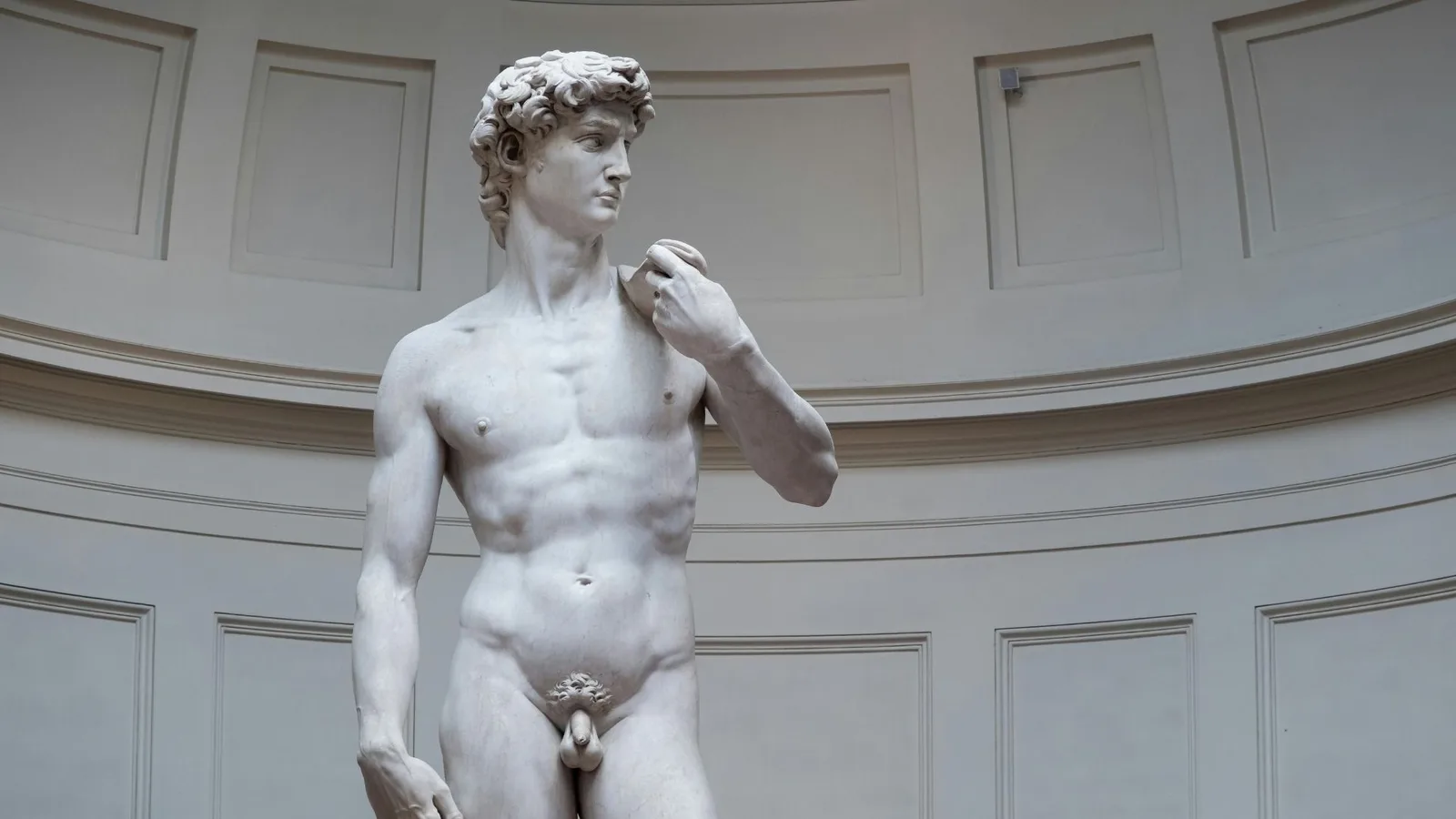
Michelangelo's David is at the Galleria dell'Accademia (the Accademia Gallery), not the Uffizi.
- Address: Via Ricasoli 58/60, Florence
- Distance from the Uffizi: about a 12-minute walk (1 km / 0.6 miles)
- Hours in 2026: Tuesday to Sunday, 8:15 AM – 6:50 PM (last entry 6:20 PM)
- Closed: Mondays, 1 January, 1 May, 25 December
- Tickets: €16 walk-up / €20 advance online / €2 EU youth (18–24) / Free under 18
Two replicas of David also stand outdoors in Florence — one in Piazza della Signoria (where the original stood until 1873) and one at Piazzale Michelangelo (overlooking the city). Both are excellent. Neither is the original. More on that below.
If you've got 30 seconds back, the rest of this article tells you why everyone gets this wrong, what to expect when you finally stand in front of David, and how to actually plan a Florence trip that includes both the Accademia and the Uffizi without burning out.
Worth Adding to Your Itinerary
Once you've seen Michelangelo's David at the Accademia Gallery, most travelers build the rest of their Florence day around it. A combined Uffizi and Accademia tour covers Botticelli's Birth of Venus the same day David sees you home, and a small-group Florence walking tour ties in the Duomo and Piazza della Signoria on the way. Art lovers should also look at the reopened Vasari Corridor above the Ponte Vecchio. The live options below update automatically for Florence experiences and skip-the-line tickets.
Why everyone thinks the David is at the Uffizi
The misconception is so widespread that the Uffizi staff has a standard line for it. There are four reasons people get this wrong, and they're all reasonable.
Reason 1: The Uffizi is Florence's most famous museum. When most travelers think "Florence + Renaissance + masterpiece," they think Uffizi. The brain fills in the David. It's lazy pattern-matching, but it's how brains work.
Reason 2: Michelangelo is in the Uffizi — just not in the form most people imagine. The Uffizi holds Michelangelo's Doni Tondo, a stunning circular painting of the Holy Family from around 1507. It's one of the only completed panel paintings he ever made, and it lives in Room 41. So the answer to "is there Michelangelo at the Uffizi" is genuinely yes — just not the one you're thinking of.
Reason 3: There's a David at Piazza della Signoria, right outside the Uffizi. It's a marble replica installed in 1910, and it stands in the exact spot where Michelangelo's original lived from 1504 to 1873. To a casual visitor walking past, it looks identical. Many people see it, photograph it, and never realize they haven't seen the real thing.
Reason 4: Travel guides are sloppy. I've read printed guidebooks that say "the David is in the Uffizi area" — technically true, geographically misleading. Online listicles cluster Florence's masterpieces together without distinguishing which museum holds what.
You're not stupid for getting this wrong. You're just one of half a million people every month asking the same reasonable question.
The three Davids of Florence
Here's something most travelers never realize: there are three statues of David in Florence by or related to Michelangelo, and confusing them is part of why this question is so common.
1. The original — Galleria dell'Accademia (since 1873)
The one you came for. 5.17 meters tall (about 17 feet), carved from a single block of Carrara marble between 1501 and 1504, when Michelangelo was 26 to 29 years old.
He stands at the end of a long gallery called the Tribuna del David, under a custom-built skylight, with the four unfinished Prigioni ("Prisoners") sculptures lining the approach corridor like a hallway of half-formed gods. The first time I rounded the corner and saw him at the end of the hall, I genuinely stopped walking. He's bigger than every photo prepares you for. The muscles in the right hand — the one holding the stone — have a vein along the back that has somehow been carved into the marble. It is impossible.
This is the original David. There is one. It is here.
2. The marble replica — Piazza della Signoria (since 1910)
The free one outside. A full-scale marble copy installed at the exact spot where the original stood for 369 years before being moved indoors. It's outside Palazzo Vecchio, two minutes from the Uffizi, completely free to see, photograph, and walk around.
Most casual tourists who say "I saw the David in Florence" have actually seen this one.
It's a good replica — installed in 1910, full-size, the right marble. It just isn't the original.
3. The bronze replica — Piazzale Michelangelo (since 1875)
The sunset one. A full-scale bronze cast at the famous viewpoint above the Arno where every Florence Instagram photo is taken. He's been there since 1875, two years after the original moved indoors. The bronze gives him a darker, almost charcoal patina against the Tuscan sky.
Worth the climb at sunset. Not the original. Don't fly home thinking it was.
Why Michelangelo's David ended up at the Accademia (and not somewhere else)
The story of how David got to his current home is genuinely interesting and explains a lot about why he isn't where you'd expect.
When Michelangelo finished David in 1504, the statue was originally meant to decorate one of the high buttresses of Florence Cathedral (the Duomo) — basically a rooftop sculpture, viewed from below. By the time the statue was complete, the city realized it was too perfect to put on a roof. A committee of Florence's biggest artists — including Leonardo da Vinci and Botticelli — was assembled to figure out where to put him instead.
They chose the entrance of Palazzo Vecchio, in Piazza della Signoria. The David became a political symbol of the Florentine Republic — the small, brave underdog facing down a giant. The Medici, recently expelled, were the implied giant.
He stood outside in that square for 369 years. Pigeons, weather, the occasional thrown chair (a real incident during a 1527 riot — a thrown bench broke his left arm, which had to be repaired). By the mid-1800s, the marble was visibly degrading. In 1873, the Italian state moved David indoors to protect him, into a custom-built room at the Accademia. He's been there ever since.
The Accademia itself was originally an art school — founded in 1784 by Grand Duke Pietro Leopoldo as a teaching collection for Academy of Fine Arts students. It only became a major public museum because David moved in. He is, in every sense, the museum's reason for existing.
How to actually visit the David
Now to the practical bit. Here's everything you need to know to see Michelangelo's David in 2026.
Where exactly the Accademia is
The Galleria dell'Accademia is at Via Ricasoli 58/60, a five-minute walk north of the Duomo and a twelve-minute walk from the Uffizi. The street is narrow and usually loud — full of people queuing for the same museum.
If you're navigating from the Uffizi: walk north on Via dei Calzaiuoli, past the Duomo, then continue on Via Ricasoli. You can't miss it — there's almost always a queue out front.
Accademia opening hours 2026
- Open: Tuesday to Sunday, 8:15 AM – 6:50 PM
- Last entry: 6:20 PM
- Closed: Every Monday, plus 1 January, 1 May (Labour Day), and 25 December
Note: the Accademia is closed on Mondays, just like the Uffizi. If your only Florence day is a Monday, you cannot see the original David — only the two outdoor replicas.
Accademia ticket prices 2026
| Ticket | Price | Notes |
|---|---|---|
| Adult walk-up (same-day) | €16 | Buy at the door if available |
| Adult advance (online) | €20 | €16 + €4 booking fee for a guaranteed slot |
| Reduced (EU 18–24) | €2 | Bring passport or EU ID |
| Under 18 | Free | Bring ID, still need a booked slot |
| First Sunday of month | Free | No booking, expect a 90-minute queue |
| Audio guide | €6 | At the entrance |
New for 2026: From 15 March 2026, you can buy a combined Accademia + Bargello ticket (€26, valid 48 hours) or a six-museum pass for the new "Galleria dell'Accademia di Firenze e Musei del Bargello" institute (€38, valid 72 hours). The Bargello holds Donatello's earlier bronze David — a completely different work, smaller, weirder, sexier. Sculpture lovers should consider the combo.
Should you book in advance?
Yes. Almost always.
The Accademia gets over 1.6 million visitors a year for one statue. Walk-up queues in peak season (April–October) regularly run 90 minutes to two hours. The €4 booking fee is the cheapest insurance you'll buy on your trip.
The only situations where walking up makes sense: a Tuesday or Wednesday in November–February, or arriving 45 minutes before closing (around 6:00 PM). Both work; everything else doesn't.
Want to see David in person? The original is inside Florence's Accademia Gallery. Entry is timed and queues can be substantial in peak season. Compare Accademia tickets → Or, if you're seeing the Uffizi too, a combined Uffizi + Accademia tour → is usually easier than booking and coordinating the two separately.
What David actually looks like in person
I've stood in front of him a dozen times now. Some honest observations to set expectations.
He is much bigger than you expect. Photographs flatten him. In person, the scale is the first thing that hits you — 17 feet of marble, lifted on a pedestal so the head sits even higher. You are looking up at him, which is the angle Michelangelo intended.
The right hand is enormous. Disproportionately so. Art historians have argued for centuries about why. Some say Michelangelo intentionally enlarged it because the statue was originally meant to be viewed from below on the cathedral roof, where the hand needed to read at distance. Others say the right hand symbolizes Florence's strength. Both might be true. Stand on his right side and the hand is the size of a small child.
The expression is not calm. Most reproductions soften this, but the real David is tense. His brow is furrowed. The veins in the neck and right hand are raised. You're looking at the moment before the slingshot — the held breath, not the victory. Once you see it, you can't unsee it.
The marble is alive. This sounds melodramatic but it's the truest thing about the experience. Carrara marble has a faint translucency that makes the surface seem to glow under the Tribuna's skylight. Photographs cannot capture this. The skin almost looks warm.
You'll spend 20–30 minutes with David. The rest of the museum gets another 30–60 minutes. Plan for 60–90 minutes total.
What else is in the Accademia
Most people come for David and treat the rest as filler. That's a mistake. Here's what else is worth your time.
The Prigioni (the "Prisoners" or "Slaves"). Four unfinished Michelangelo sculptures lining the corridor that leads to David. They were originally commissioned for Pope Julius II's tomb but never completed. They look like figures struggling to escape from blocks of stone — limbs and torsos emerging while heads and feet remain locked in marble. They are arguably more interesting than David himself. The unfinished state shows how Michelangelo worked: he didn't sculpt by adding, he sculpted by removing, freeing the figure he believed was already trapped inside the stone.
Saint Matthew (also unfinished). Another Michelangelo work-in-progress, in the same corridor.
The Sala del Colosso. The first major room you enter, dominated by a plaster model of Giambologna's Rape of the Sabine Women and lined with early 16th-century Florentine paintings — Perugino, Filippino Lippi, Fra Bartolomeo. This is the room that shows you the artistic world Michelangelo was working in.
The musical instruments collection. Often skipped. Contains rare instruments from the Medici and Lorraine collections, including a Stradivarius. Worth ten minutes if you have time.
Pietà of Palestrina. Attributed to a mature Michelangelo, though the attribution is debated. Quietly devastating.
If you only have an hour: do the Prigioni corridor slowly, give David the time he deserves, then walk back through the Sala del Colosso. Skip the rest. If you have two hours: see everything. The musical instruments room is genuinely lovely.
Every other place to see Michelangelo in Florence
Once you know David is at the Accademia, the next question is usually what else of his is here. The answer is: a great deal, spread across at least ten sites. Here is every major one, with what is there and how it fits a practical visit.
Uffizi Gallery: the Doni Tondo
The Doni Tondo is Michelangelo's only finished panel painting to survive, and the only major Michelangelo painting in Florence. It is tied to Agnolo Doni's marriage to Maddalena Strozzi in 1504 and entered the Uffizi's Tribuna in 1635. The circular composition of electric pinks, blues and greens is the clearest reminder that Michelangelo's painted figures still think like sculpted bodies. Standard admission covers it, so it works best as part of a broader Renaissance route than as a separate booking — see our Uffizi ticket guide.
Medici Chapels: the New Sacristy and the secret room
The New Sacristy was designed and populated by Michelangelo between 1519 and 1534 — the tombs of Giuliano and Lorenzo de' Medici, crowned by Dawn, Dusk, Night and Day, plus the Medici Madonna. It is one of the supreme fusions of architecture and sculpture in the Renaissance.
Beneath it lies the so-called secret room, where Michelangelo is thought to have sheltered in 1530 while the Medici hunted republican opponents. It opened to the public in November 2023 and remains one of the hardest tickets in Florence: four visitors per 15-minute slot, sold out months ahead, reached by a narrow staircase.
Bargello: Bacchus, Pitti Tondo, Brutus, David-Apollo
A superb group of early and mid-career works, and far quieter than the Accademia or Uffizi — one of the best-value additions for anyone wanting more than the headline stop.
Casa Buonarroti
Two of his earliest sculptures, the Madonna of the Stairs and the Battle of the Centaurs, both carved as a teenager, plus the wooden model for the never-built facade of San Lorenzo and one of the richest collections of his drawings anywhere. The best stop for origins rather than fame.
Opera del Duomo Museum: the Bandini Pieta
One of his last and most personal sculptures, carved in his final years and intended for his own tomb — the figure of Nicodemus is generally read as a self-portrait. This is the late, reflective Michelangelo rather than the triumphant young sculptor of David, and the museum sits behind the cathedral complex where David was originally meant to stand.
Palazzo Vecchio: Genius of Victory
In the Salone dei Cinquecento stands the marble Genius of Victory, carved around 1530–34 for the tomb of Pope Julius II. The room also carries the memory of the abandoned Leonardo–Michelangelo battle-scene rivalry.
Laurentian Library
In the San Lorenzo complex, one of his most important architectural works — the dramatic vestibule and staircase. Easy to miss and quieter than the Chapels, but essential if you care about Michelangelo as an architect. Hours can be limited, so check the same week.
Santo Spirito and Santa Croce
Santo Spirito in the Oltrarno displays a wooden Crucifix attributed to the young Michelangelo — a useful shift in scale after the big museums. Santa Croce is his burial place; the tomb, designed by Vasari, carries allegorical mourning figures for Painting, Sculpture and Architecture.
A note on the paintings
Worth clearing up, because it causes the same confusion as the David question: Michelangelo's most famous paintings — the Sistine Chapel ceiling and the Last Judgment — are in Rome, not Florence. In Florence there is exactly one major Michelangelo painting, the Doni Tondo. Everything else that matters here is sculpture, architecture or drawing.
A one-day Michelangelo itinerary
A realistic route that sees the essential works in a single day:
- 8:15 AM — Accademia Gallery. David, the Prisoners and St Matthew while the museum is still quiet.
- 9:45 AM — Medici Chapels and San Lorenzo, for the New Sacristy sculptures.
- 11:00 AM — Casa Buonarroti or the Bargello, depending on whether you want early reliefs or a broader sculpture museum.
- 1:00 PM — Lunch near Piazza della Signoria, where the outdoor marble David copy and Palazzo Vecchio are.
- 4:00 PM — Uffizi Gallery. The late-afternoon ticket window (€16 since January 2026) is the cheapest and calmest way to see the Doni Tondo.
With two days, split the museums across two mornings, add the Opera del Duomo Museum on day one, and use day two for Santo Spirito, Piazzale Michelangelo and Santa Croce. That version lets the city breathe instead of turning the route into a sprint.
Should you visit both the Uffizi and the Accademia?
Almost certainly yes. They are different museums covering different art forms, and skipping either is a real loss.
The Uffizi is for Renaissance painting: Botticelli's Birth of Venus and Primavera, Leonardo da Vinci's Annunciation, Caravaggio's Medusa, Titian's Venus of Urbino, and Michelangelo's Doni Tondo (yes, his only finished panel painting — it lives at the Uffizi).
The Accademia is for Michelangelo's sculpture: the David, the Prigioni, Saint Matthew, the Pietà of Palestrina.
You can do both in a single day if you're efficient. Here's the rhythm I recommend.
The two-museum day:
- 8:15 AM — Uffizi entry (book a 9:00 AM slot at the latest)
- 11:00 AM — leave Uffizi, walk twelve minutes through the centre
- 11:30 AM — coffee and a snack at one of the cafés near the Duomo
- 12:30 PM — Accademia entry (book a 12:30–1:00 PM slot)
- 2:00 PM — out, late lunch, you've earned it
If that sounds like a lot, split them across two days — Uffizi day one, Accademia day two — with the cathedral, Palazzo Vecchio, and Ponte Vecchio scattered in between. Both work. Both better than skipping one.
The cleanest way to do both: Compare Uffizi + Accademia combo tours → One booking, two reserved entries, both timed slots locked in. Free cancellation up to 24 hours before on most options.
Frequently asked questions
Is Michelangelo's David at the Uffizi? No. The original David is at the Galleria dell'Accademia, a separate museum about a 12-minute walk from the Uffizi. The Uffizi holds Michelangelo's Doni Tondo (a painting), which is sometimes the source of the confusion.
What museum is Michelangelo's David in? The Galleria dell'Accademia (Accademia Gallery) at Via Ricasoli 58/60, Florence. It has been there since 1873.
Where is Michelangelo's David located? The original is in the Galleria dell'Accademia in Florence, Italy. Two replicas also stand in Florence — one outdoors in Piazza della Signoria (the original location) and one at Piazzale Michelangelo (the panoramic viewpoint above the Arno).
Can you see the David in Florence for free? You can see the two replicas for free — the marble copy in Piazza della Signoria and the bronze copy at Piazzale Michelangelo. To see the original at the Accademia, you need a ticket (€16 walk-up or €20 advance), unless you visit on the first Sunday of the month, when admission is free for everyone.
How tall is Michelangelo's David? 5.17 meters, or about 17 feet (just over 5 yards). Carved from a single block of Carrara marble between 1501 and 1504.
How old was Michelangelo when he carved David? He started at 26 and finished at 29.
Why was David moved indoors? By the mid-1800s, 350+ years of weather, pollution, and the occasional accident had visibly damaged the marble. In 1873, the Italian state moved the original to a custom-built room at the Accademia to protect it. The replica in Piazza della Signoria was installed in 1910 to fill the empty space.
Where in Florence is the Accademia Gallery? Via Ricasoli 58/60, a 5-minute walk north of the Duomo and a 12-minute walk from the Uffizi.
Is the Accademia worth visiting if I've already seen the replicas? Yes. The original is a fundamentally different experience — different lighting, different scale, different surface, different proximity. The Prigioni corridor leading up to David is also unique to the Accademia and is one of the most powerful single rooms in any museum in Italy.
Can I touch the David? No. He's behind a low railing about three meters out, and there's always a guard on duty.
Can I take photos of the David? Yes. No flash. Phones only — no professional cameras or tripods.
How long should I plan for the Accademia? 60–90 minutes is comfortable for most visitors. 30 minutes is the absolute minimum for David alone. Two hours if you want to see everything properly.
Is the David worth seeing if my time in Florence is short? Yes. If you have to choose between Uffizi and Accademia and have only one museum slot — that's a genuinely hard call, and it depends on whether you prefer painting (Uffizi) or sculpture (Accademia). But David is one of the half-dozen most famous artworks on Earth, and seeing the original is a different category of experience from seeing photos. If sculpture moves you at all, prioritize him.
The bottom line
Michelangelo's David is not at the Uffizi. He never has been. He lives at the Galleria dell'Accademia, twelve minutes' walk away, in a room that was custom-built for him in 1873 and has held him ever since.
If you came to Florence to see David, do not leave Florence without seeing him — and do not see only the replicas. The original is worth every minute of the booking process, every euro of the ticket, and every step of the queue you didn't have to stand in because you booked ahead.
The couple from Manchester I mentioned at the start? I think about them sometimes. If you're reading this article, you're not them. You won't be them. You'll book the right ticket, walk to the right museum, and stand in front of one of the most extraordinary objects ever made by human hands.
Ready to see the original? Compare Accademia tickets → or take the Uffizi + Accademia combo → Both museums, both reserved entry, one booking.