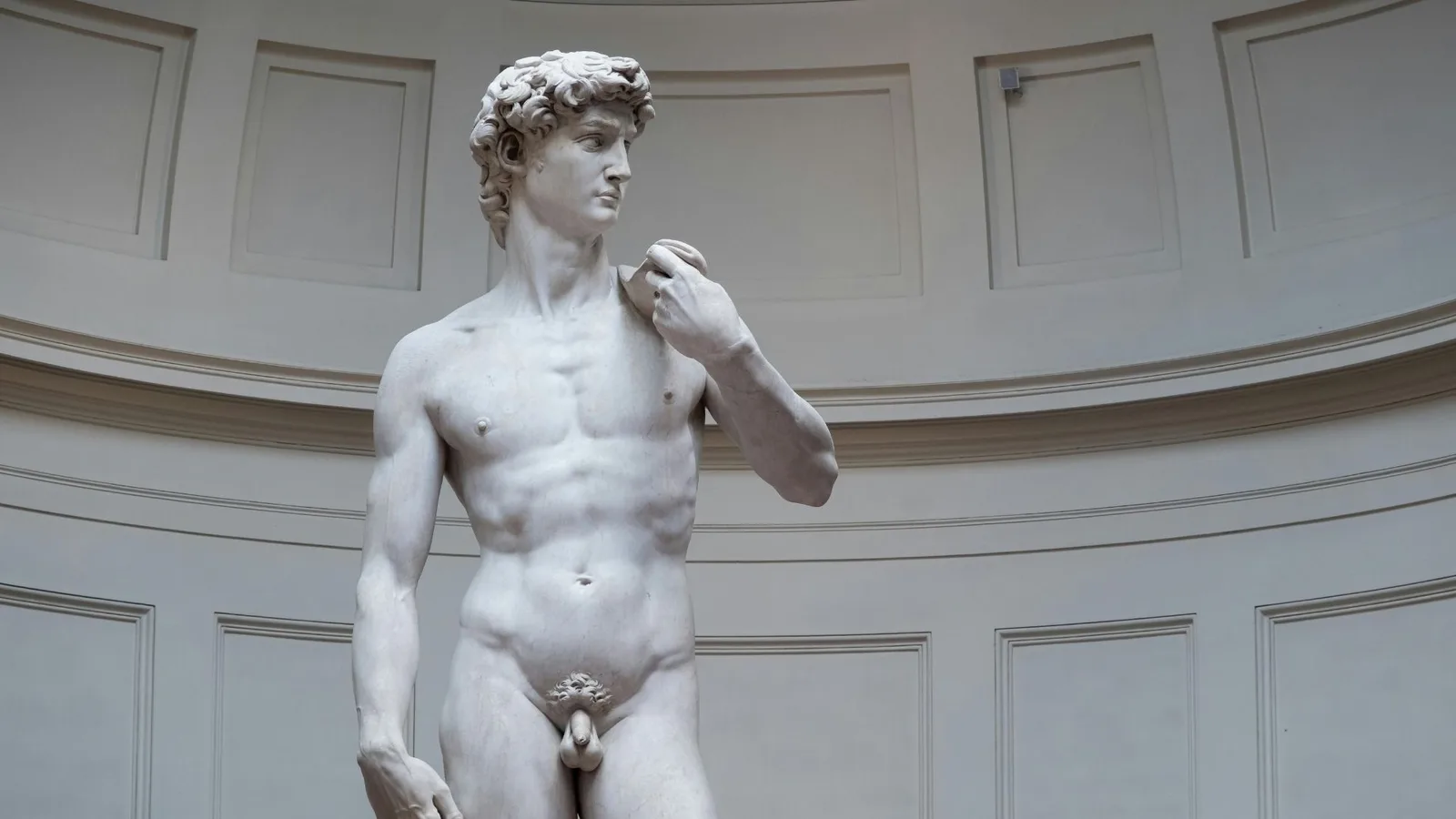
The Galleria dell'Accademia — Florence's Accademia Gallery — is the second-most-visited museum in the city and the home of Michelangelo's David, the 5.17-metre marble colossus that draws millions of visitors a year to a single corridor in the heart of Florence. According to the Italian Ministry of Culture's figures, the Accademia drew over 2.1 million visitors in 2024 (generating around €17.1 million in gross revenue), second in Florence only to the Uffizi, which recorded nearly 5.3 million. If you are planning a trip to Florence, this is one of the two museums that belongs on almost every itinerary, and because it is small and permanently busy, it rewards a little planning more than almost any other sight in the city.
This complete guide to the Accademia Gallery covers everything you need before you go: the story and staggering detail of the David statue, what else is worth your time inside, 2026 ticket prices and how to book skip-the-line entry, opening hours and the best time to visit, how to get there, and how the Accademia compares with the Uffizi. Whether you are searching for "accademia gallery tickets," "accademia gallery david," or simply "what to see," you will find the answers below.
If you already know you want guaranteed entry to see the statue, you can secure David skip-the-line tickets here.
Michelangelo's David: The Star of the Accademia Gallery
Make no mistake — the reason the crowds queue on Via Ricasoli is David. Michelangelo carved the statue between 1501 and 1504, beginning at the age of 26 after the commission was formally assigned to him on 16 August 1501 for a fee of 400 ducats. He worked from a single block of white Carrara marble that had already defeated two earlier sculptors. The block, quarried from the Fantiscritti quarries at Miseglia in the Apuan Alps above Carrara, had been roughed out by Agostino di Duccio around 1464 and briefly taken up by Antonio Rossellino in 1476 before being abandoned for decades in the courtyard of the cathedral workshop. Michelangelo took the flawed, partly-worked stone and produced what many consider the greatest sculpture in Western art.
How big is the David statue?
According to the Galleria dell'Accademia, the sculpture with its carved base is 517 cm (5.17 metres, about 17 feet) high and weighs 5,560 kilos — roughly three times life size, and all solid marble. It was the first colossal marble statue produced in the High Renaissance and the first since classical antiquity, setting a precedent that echoed through the following century.
The details most visitors miss
Michelangelo captured David not after his victory — as Donatello and Verrocchio had done in bronze — but in the tense moment before the fight with Goliath. His brow is furrowed, his nostrils flared, his eyes narrowed and fixed on an unseen enemy, and his neck and hands taut with contained energy. The pose is a masterclass in contrapposto: David's weight rests on his right leg while the left is relaxed, tilting the hips and shoulders in a gentle S-curve that makes the marble seem alive.
Look closely and you will notice the famous "disproportions." David's head and hands — especially the right hand gripping the stone — are deliberately oversized. This was an optical correction: the statue was originally intended to sit high on a buttress of Florence Cathedral, so Michelangelo enlarged the features that mattered most for expression and gesture, ensuring they would read correctly when viewed from below. The pupils of the eyes are carved rather than painted, adding to the intensity of his gaze.
From Piazza della Signoria to the Accademia
David was never installed on the cathedral. When it was completed in 1504, a committee that included Leonardo da Vinci, Sandro Botticelli, Filippino Lippi and Perugino decided it was too magnificent to be hoisted out of sight, and it was placed instead at the entrance of the Palazzo Vecchio in Piazza della Signoria, where it became a symbol of the independent Florentine Republic. It stood outdoors for almost 370 years. By the mid-19th century, weathering and cracks in the left leg prompted the decision to move it indoors, and in 1873 the statue was transported slowly and carefully across the city over several days. It then waited years before its permanent display was ready. The purpose-built domed Tribune, designed by architect Emilio De Fabris, bathes the statue in natural light from above and was built to house it.
Today three Davids stand in Florence: the original in the Accademia, a marble replica installed in Piazza della Signoria in 1910 on the statue's original spot, and a bronze copy overlooking the city from Piazzale Michelangelo. If you want the full story of the various statues and where to find each one, see our guide to where Michelangelo's David is.
What Else to See at the Accademia
Most visitors come for David and leave within the hour, but the Accademia holds the largest collection of Michelangelo sculptures in the world plus several other treasures. Here is what to look for.
Michelangelo's Prisoners (the Slaves)
The corridor leading to David — the Galleria dei Prigioni — is lined with Michelangelo's four unfinished Prisoners (also called Slaves or Captives): the Awakening Slave, the Young Slave, the Bearded Slave and the Atlas. Carved for the ill-fated tomb of Pope Julius II, these figures appear to be wrestling their way out of the raw marble, and they are the finest illustration anywhere of Michelangelo's non-finito technique and his belief that the figure already existed within the stone. After his death they decorated the Buontalenti Grotto in the Boboli Gardens before arriving at the Accademia in 1909. Also in this area are two more unfinished Michelangelo works: the St. Matthew and the Palestrina Pietà — though experts now consider the latter's attribution to Michelangelo doubtful.
The Hall of the Colossus
The first room you enter, the Sala del Colosso, is dominated by the full-size plaster model of Giambologna's Rape of the Sabine Women — a rare, intact 16th-century clay-and-plaster model at 1:1 scale for the marble that stands in the Loggia dei Lanzi in Piazza della Signoria. The surrounding walls hold important 15th- and 16th-century Florentine paintings, including works associated with Botticelli, Ghirlandaio, Perugino, Filippino Lippi and Pontormo.
The paintings: Gothic gold grounds and Renaissance masterpieces
The Accademia's painting collection is genuinely important and often overlooked. It includes an outstanding group of 13th- to early-15th-century gold-ground paintings by Florentine masters — among them Giotto, Bernardo Daddi, Taddeo Gaddi, Orcagna and a fine body of work by Lorenzo Monaco — displayed across the Byzantine and Gothic rooms. Botticelli's Madonna of the Sea is among the highlights. These galleries are usually far quieter than the Tribune.
The Museum of Musical Instruments
Down a corridor off the entrance, the Department of Musical Instruments (opened in 2001) displays around fifty instruments from the collections of the Medici and Lorraine grand dukes, drawn largely from Florence's Luigi Cherubini Conservatory. The stars are a tenor viola and a cello made by Antonio Stradivari in 1690 for a quintet commissioned by Grand Prince Ferdinando de' Medici, a 1650 cello by Niccolò Amati, and an oval spinet by Bartolomeo Cristofori — the Florentine who went on to invent the piano. It is one of the quietest and most rewarding rooms in the building.
The Gipsoteca Bartolini
Off the Tribune lies the Salone dell'Ottocento, home to the Gipsoteca Bartolini — a plaster-cast gallery recreating the studio atmosphere of the 19th-century sculptor Lorenzo Bartolini and his pupil Luigi Pampaloni. Rows of white plaster models, many marked with the reference points used to transfer measurements into marble, are displayed alongside 19th-century paintings. The hall reopened after an important restoration and is one of the most atmospheric spaces in the museum.
Accademia Gallery Tickets & Prices 2026
The Accademia is small and admits a limited number of visitors in timed 15-minute windows, so advance booking is strongly recommended — in peak season it is essential.
2026 ticket prices
- Full ticket: €16.00 (in effect since 1 January 2024)
- Online reservation / booking fee: €4.00 — so a standard adult ticket booked in advance costs €20.00
- Reduced ticket: €2.00 for EU citizens aged 18–24 (until the day of the 25th birthday); the reduction also applies to certain non-EU nationals. The €4 booking fee still applies.
- Free: all visitors under 18, regardless of nationality (children under 12 must be accompanied by an adult). A valid ID proving age is required, and the €4 booking fee still applies if you reserve.
New for 2026: following the museum's merger with the Bargello into a single institution (the Galleria dell'Accademia di Firenze e Musei del Bargello), two combined passes were introduced. An Accademia + Bargello 48-hour pass costs €26 (plus the €4 booking fee), and a six-museum 72-hour pass costs €38 (plus fee), covering the Accademia, Bargello, Medici Chapels, Palazzo Davanzati, Orsanmichele and Casa Martelli. The Bargello holds Donatello's bronze David and Michelangelo's early Bacchus, making the 48-hour combo an excellent choice for anyone serious about Renaissance sculpture.
The official website and where to book
The official Accademia Gallery website is galleriaaccademiafirenze.it. The museum does not sell tickets directly on that site; instead it links to its official booking platform, b-ticket.com (operated by Firenze Musei / Opera Laboratori for the Italian Ministry of Culture), which is the only official online seller. Be aware that many high-ranking search results are unofficial resellers, not the museum's own site.
Skip-the-line and why advance booking matters
At the Accademia there are effectively two queues: one for people who have booked a timed entry, which moves quickly, and one for people buying tickets on the spot, which can stretch down Via Ricasoli for a very long time in high season — waits of up to two hours are common. A booked timed-entry ticket is your skip-the-line ticket — it lets you bypass the ticket-purchase queue, though everyone still passes through a short security check.
Booking directly through the official b-ticket platform gives you the lowest price, but it comes with a strict no-refund, no-change policy — no refunds for errors, cancellations or unused tickets. Third-party platforms typically charge a little more but offer free cancellation up to 24 hours before your visit and bundle in extras such as guided tours or audio guides, which is worth it if your plans might shift. In peak season, timed slots — especially the early-morning ones — sell out weeks ahead, so book as soon as your dates are set. The most reliable way to guarantee entry is a skip-the-line David ticket booked in advance.
Guided tours and audio guides
Guided tours of the Accademia typically run around 1 to 1.5 hours and are offered in English, Spanish, French, Italian, German and other languages, with skip-the-line entry included. A licensed guide adds enormous context to David, the Prisoners and the collection, and is a good choice if you have limited time or want the stories behind the art. If you prefer to explore at your own pace, the museum's official audio guide runs about 75 minutes, is available in several languages including English, and can be picked up at the bookshop or added to your ticket for a small fee. There is no cloakroom, so travel light — large bags and backpacks are not allowed inside.
Opening Hours & the Best Time to Visit
Accademia Gallery opening hours
The Accademia is open Tuesday to Sunday, 8:15 am to 6:50 pm, with the last admission at 6:20 pm (the ticket office closes at the same time). It is closed every Monday, as well as on 1 January and 25 December; some sources also note a 1 May closure, so confirm before a public-holiday visit. Because it closes on Mondays, Tuesdays — especially Tuesday mornings — tend to be busy.
In summer the museum sometimes offers extended evening openings on Tuesdays (until around 10 pm), and these evening slots are among the calmest and most atmospheric times to see David with the tour groups gone. In 2025, for example, the museum stayed open until 10 pm every Tuesday from 3 June to 22 July (last admission 9:15 pm). The exact 2026 evening dates were not yet confirmed on the official website at the time of writing, so check galleriaaccademiafirenze.it before relying on an evening visit.
Free entry days
As part of Italy's Domenica al Museo programme, admission is free on the first Sunday of every month — in 2026 that falls on 4 January, 1 February, 1 March, 5 April, 3 May, 7 June, 5 July, 2 August, 6 September, 4 October, 1 November and 6 December — plus the national free days of 25 April, 2 June and 4 November 2026. There is a catch: on free days you cannot book in advance, so entry is walk-up only and the queue is often longer than a normal peak-season line — waits of one to two hours are common in summer. If your time in Florence is limited, the free entry can cost you more in queuing than the price of a ticket. If you want to try it, arrive well before the 8:15 am opening.
The best time to visit
The single best strategy is to book the 8:15 am opening slot — the Tribune is at its emptiest, and by 10 am it is ringed several people deep with tour groups. Late afternoon, after about 5 pm, is the next-best window. Wednesday, Thursday and Friday are quieter than the Monday-closure-driven Tuesday rush and the busy weekends, and the low season from November to March (excluding the Christmas period) is quieter across the board. Plan on 45 minutes to 1.5 hours for a visit — enough to enjoy David, walk the Prisoners corridor and pass through the painting galleries, with more time if you linger.
How to Get to the Accademia Gallery
The Accademia is at Via Ricasoli 58/60, on a narrow street running between Piazza del Duomo and Piazza San Marco in the historic centre — the block closest to San Marco. Florence's centre is compact and walkable, and for most visitors walking is the simplest option:
- From the Duomo: about a 5–7 minute walk north up Via Ricasoli.
- From Piazza San Marco: roughly a 2-minute walk south.
- From the Uffizi: a pleasant 12–15 minute walk north through the centre.
- From Santa Maria Novella train station: about a 15-minute walk.
If you prefer public transport, several bus lines (including 6, 14, 23 and 31) stop near Piazza San Marco, a few minutes' walk away. Driving is not recommended: the centre is a restricted-traffic (ZTL) zone, there is no parking at the museum, and paid garages nearby fill quickly. The gallery's proximity to San Marco, the Duomo and the Mercato Centrale makes it easy to combine with other sights.
Accademia vs Uffizi: Which to Visit?
Travellers planning Florence almost always weigh the Uffizi against the Accademia, and the good news is they answer different questions — so if you can, do both. They sit about a 15-minute walk apart and can comfortably be combined in a single day.
The Uffizi is a marathon: over 2,000 works across roughly 100 rooms, tracing Renaissance painting from Giotto to Caravaggio, with Botticelli's Birth of Venus and Primavera, Leonardo, Raphael, Titian and more. It rewards a plan and needs two to three hours or more. Its scale shows in the numbers, too — it drew nearly 5.3 million visitors in 2024, more than double the Accademia. For a full walkthrough of its star paintings, see our Uffizi Gallery highlights guide.
The Accademia is a sprint: focused, manageable in 45–90 minutes, and built around one of the most famous objects on Earth. It is the better pick if you have limited time, are travelling with children, or came to Florence specifically for David.
If you only have time for one museum on a first visit and love painting, choose the Uffizi for the full sweep of the Renaissance. If sculpture and Michelangelo are your priority, choose the Accademia. The ideal plan for a full day is the Accademia first, at the 8:15 am opening (60–90 minutes), then walk to the Uffizi for around 10 am before the worst crowds build — a combo approach that gets you into both before the afternoon rush. Note that Florence discontinued official combined Uffizi-Accademia tickets, so you buy each separately or book a combined guided experience through a tour operator.
Planning the paintings side of your day? Start with our Uffizi Gallery tickets guide and our Uffizi one-day guide.
Frequently Asked Questions
Is David in the Accademia or the Uffizi?
The original David is in the Accademia Gallery (Via Ricasoli 58/60), not the Uffizi. This is the single most common booking mistake in Florence. The statue was moved to the Accademia in 1873; a replica stands in Piazza della Signoria and a bronze copy at Piazzale Michelangelo.
How much are Accademia tickets?
The full ticket is €16, or €20 when booked online in advance (€16 admission + €4 reservation fee). EU citizens aged 18–24 pay a reduced €2, and under-18s enter free (the €4 booking fee still applies to advance reservations). New 2026 combined passes cost €26 (Accademia + Bargello, 48 hours) and €38 (six museums, 72 hours), each plus the booking fee.
Do you need to book the Accademia in advance?
It is strongly recommended, and essential in peak season (roughly April–October), when timed slots sell out weeks ahead. Booking a timed entry lets you skip the long ticket-purchase queue. You can buy on the day at the box office, but expect a long wait or a sold-out sign in high season.
How long does the Accademia take?
Most visitors spend 45 minutes to about 1.5 hours. That is enough time for David, the Prisoners corridor and a pass through the paintings and musical-instrument rooms. Art lovers who want to linger can happily spend two hours or more; there is no time limit once inside.
Is the Accademia worth it?
Yes — seeing the real David in person is a genuinely different experience from any photograph, and the museum's small size makes it an easy, high-impact visit even on a tight schedule. If you have more than a day in Florence and love painting, pair it with the Uffizi and its masterpieces for the complete picture of the Renaissance, or use our Michelangelo in Florence guide to build a broader artist-focused route.
Worth Adding to Your Itinerary
The Accademia takes barely 90 minutes, so most travelers build a fuller Florence day around it. A few steps away are the Uffizi Gallery and Botticelli's Birth of Venus, the Duomo, Brunelleschi's Dome and Giotto's bell tower, and the Bargello with Donatello's bronze David. Popular add-ons include a Florence walking tour, a Tuscan cooking class, and day trips to Pisa, Siena, San Gimignano and the Chianti wineries. The live options below refresh automatically for Florence tours, tickets and experiences.