Florence was practically built for walking. Its UNESCO-listed historic centre covers just 505 hectares, most of it pedestrianised, and nearly every landmark you have come to see, the Duomo, Piazza della Signoria, the Ponte Vecchio, the Uffizi and the Accademia, sits within a short stroll of the next. That compactness is why a walking tour of Florence, whether free, self-guided or private, is one of the best ways to understand the city.
This guide explains how free walking tours in Florence actually work, gives you a complete self-guided route with stop-by-stop timing, and helps you decide between free tours, paid small-group tours and private guides. It finishes with practical tips on timing, safety and how to pair a walk with skip-the-line museum tickets.
Free Walking Tours of Florence: How They Work
A free walking tour in Florence is really a tip-based or pay-what-you-wish tour. There is no fixed price and it usually costs nothing to reserve a spot online; at the end, if you enjoyed it, you tip the guide what you feel the experience was worth. This model has become one of the most popular ways to get orientated in the city on a first day.
Because the tip covers the guide's time and not admission fees, free walking tours stick to streets, squares and building exteriors. A typical route takes in the exterior of the Duomo, the Baptistery and Giotto's Campanile, Orsanmichele, Via de' Calzaiuoli, Piazza della Signoria, the Uffizi courtyard and the Ponte Vecchio, woven together with Medici and Renaissance history. Sunset versions often cross the Arno into the Oltrarno.
Most free tours run about 2 to 2.5 hours and keep groups relatively small. Common meeting points are Piazza Santa Maria Novella, Piazza della Repubblica, the square in front of San Lorenzo, or Piazza dell'Unità Italiana near the train station. Guides usually carry a flag or umbrella, so arriving ten minutes early helps.
Tipping is discretionary, but in practice most travellers leave around €10-€20 per person for a good tour. Bring cash, because that is still how guides are usually paid. One extra thing worth knowing: Italy treats tour guiding as a regulated profession, so if art-historical depth matters to you, it is worth checking whether your guide is licensed.
Rule of thumb: treat a free Florence walking tour as orientation, not completion. It helps you understand the street plan and the main squares, but it does not remove the need to think about the Uffizi, David or the Duomo separately.
Self-Guided Walking Tour of Florence: The Complete Route
If you would rather set your own pace, a self-guided walking tour of Florence is genuinely easy to pull off. The centre is small, flat and signposted, and the Duomo's dome is visible above the rooftops as a natural compass. The loop below runs roughly 4 kilometres of actual walking and connects the essential sights. Pure walking time is around 2 to 2.5 hours; budget 4 to 5 hours if you stop for photos, coffee and gelato, and a full day if you go inside the major monuments.
Stop 1: Santa Maria Novella. If you are arriving by train, begin here. The basilica's green-and-white marble facade is one of the most influential in Florence and is often overlooked by visitors rushing to the Duomo.
Stop 2: Piazza del Duomo. The cathedral, Baptistery and Giotto's Campanile form the spiritual heart of the city. The cathedral itself is free to enter, but the exterior alone is the highlight for many first-time visitors. The Baptistery's famous east doors are replicas; the restored originals are in the Opera del Duomo Museum. This is also a notorious pickpocket spot, so keep your bag in front of you while everyone is looking up.
Stop 3: Via de' Calzaiuoli and Orsanmichele. This wide pedestrian street links the Duomo to Piazza della Signoria. About halfway down stands Orsanmichele, where you can still enjoy a free open-air survey of early Renaissance sculpture from the street. Its upper floors now function as a proper museum too, but the exterior sculptures alone already justify the stop.
Stop 4: Piazza della Signoria and the Loggia dei Lanzi. Florence's political heart opens into an L-shaped square dominated by Palazzo Vecchio. The Loggia is one of the city's best free sculpture stops, and the David replica outside is still one of the most photographed sculptures in Florence.
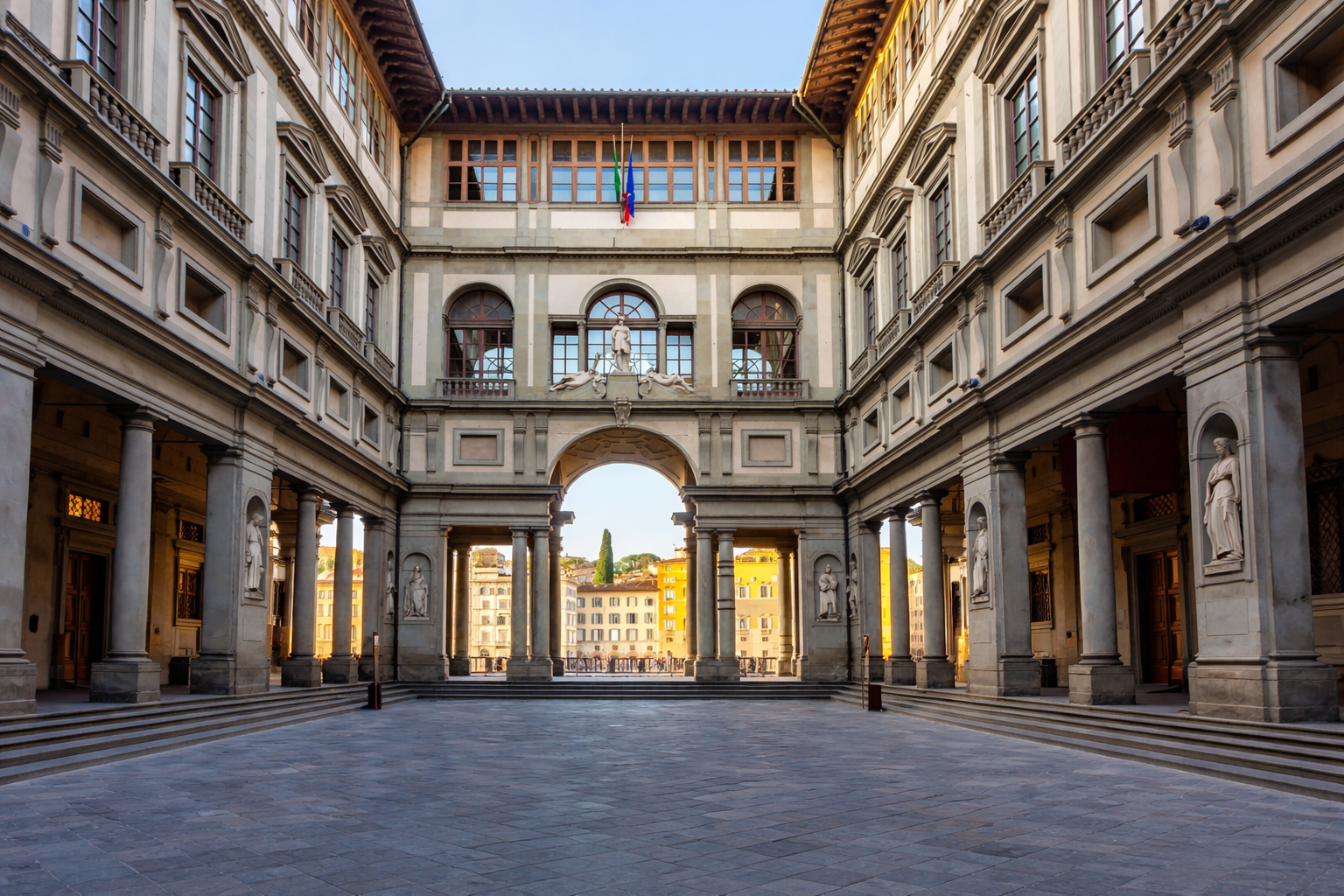
Stop 5: Uffizi courtyard. Even without a ticket, you can walk the long courtyard between the Uffizi wings down toward the Arno. It is one of the most elegant urban spaces in Florence and the natural hinge between Piazza della Signoria and the river.
Stop 6: Ponte Vecchio. Florence's most famous bridge has spanned the Arno since 1345 and was the only Florentine bridge spared by the retreating German army in August 1944. For the postcard photo of the bridge rather than from it, walk over to Ponte Santa Trinita. If you want to extend the route, this is also where the Oltrarno detour begins.
Optional detour: Oltrarno, Santo Spirito and Piazzale Michelangelo. Cross the bridge into the artisan quarter, continue toward Santo Spirito or Pitti, or climb toward Piazzale Michelangelo for the city's classic panorama. This adds serious time and should be treated as a half-day extension rather than part of the tight central loop.
Stop 7: Palazzo Vecchio courtyard. Back on the north bank, return to Piazza della Signoria and step into the inner courtyard if you want a quick architectural stop without committing to the museum.
Stop 8: Bargello exterior. The Bargello is one of Florence's oldest public buildings and one of the easiest worthwhile detours on foot, even if you only admire it from outside.
Stop 9: San Lorenzo and Mercato Centrale. This is the practical lunch stop. The Medici parish church, the surrounding market and the food hall make it a natural midpoint in a self-guided Florence day.
Stop 10: Piazza San Marco and the Accademia. A block south on Via Ricasoli is the Accademia, where Michelangelo's original David stands at the end of the corridor lined with the unfinished Prisoners. If David matters to you, this is where the walking route becomes a museum day.
Stop 11: Piazza della Santissima Annunziata. One of Florence's calmest and most harmonious squares, and a good contrast with the density of the Duomo area.
Stop 12: Return to the Duomo. Via dei Servi brings you back to the cathedral with one of the best framed views of the dome.
Free vs Paid vs Private Walking Tours: Which Should You Choose?
Free tours are the best-value orientation for first-time visitors and budget travellers. They usually work out to roughly €10-€20 per person in tips for a 2 to 2.5 hour overview, but they do not include museum entry and generally stay outside the ticketed sites.
Paid small-group tours usually run 2 to 4 hours and often bundle skip-the-line museum entry. In Florence these commonly fall somewhere around €50-€150 per person depending on museum access, and they make the most sense when you want a guide inside the Uffizi or Accademia, guaranteed timed entry and less logistical friction.
Private guides are priced per group rather than per person, so they get better value the larger your party. Independent licensed guides commonly charge by the hour, with half-day and full-day rates rising into the low hundreds of euros before tickets. They are strongest for families, older travellers, people with specific interests, and anyone who wants a more flexible pace and the chance to ask unlimited questions.
Licensing matters in Italy. Tour guiding is a regulated profession, and the newer national qualification system replaced the old region-by-region structure. In practical terms, if you want reliable art-historical commentary or legal access to guide-led museum interiors, a properly licensed guide is what you are paying for.
Best Time for a Florence Walking Tour
Early morning is the sweet spot. Reach the Duomo or Ponte Vecchio before about 9am and the streets still feel relatively calm. The stretch between the Duomo and Piazza della Signoria gets heavily congested from around 10am to 4pm, so front-loading the walk pays off.
Sunset is the other magic window, especially in summer when a late-afternoon or evening walk avoids the worst heat. Cooler temperatures, warmer light and thinning crowds make it ideal for photos, especially around the Arno.
Seasonally, spring and autumn are the easiest walking months. July and August are hot and busy; November and January to mid-March are the quietest.
What to Bring and Practical Tips
- Comfortable shoes with grip: Florence's stone surfaces can be uneven and slick after rain.
- A refillable water bottle: public drinking fountains are common in the center.
- Sun and rain cover: a hat and a compact umbrella do a lot of work here.
- Layers or a scarf: useful if you want to step into churches with dress-code expectations.
- A cross-body bag worn in front: pickpocketing is still the main safety risk in tourist-heavy parts of Florence.
Florence is generally a safe city to walk, even at night in the well-lit center, but stay alert around the Duomo, Ponte Vecchio, Santa Maria Novella station, museum queues and crowded buses or trams. Violent crime is rare; petty theft and distraction-based pickpocketing are the issue to watch for. In an emergency, Italy's general emergency number is 112.
Combining a Walking Tour with Museum Tickets
The smartest way to see Florence is to treat the free streets and squares as one experience and the ticketed interiors as another, then combine them. A self-guided or free walking tour covers what you can enjoy from the outside; skip-the-line museum tickets or a guided museum tour handle the parts you cannot.
Many operators already build exactly this bridge, bundling a guided walk of the historic centre with skip-the-line entry to the Accademia for David and the Uffizi for Botticelli and Leonardo. These combinations are popular because pre-reserved timed entry lets you bypass long queues while an expert connects the art inside to the city outside.
If you prefer to go independently, pre-book your museum tickets and slot them into the route above. Reserve the Uffizi for the stretch around Piazza della Signoria, and the Accademia for the northern loop near Piazza San Marco. Our one-day Florence itinerary guide shows how to sequence both efficiently.
Frequently Asked Questions
Are free walking tours in Florence actually free? Not entirely. They are tip-based, so booking costs nothing up front but guides work for gratuities. Most travellers tip around €10-€20 per person for a good tour.
How long is a walking tour of Florence? Guided free tours generally last 2 to 2.5 hours. A self-guided loop of the main sights takes about 2 to 2.5 hours of walking, or 4 to 5 hours with stops.
Can you walk around Florence without a tour? Absolutely. The historic centre is compact, flat and largely pedestrianised, with the Duomo's dome acting as a constant landmark.
Is Florence safe to walk around? Yes. Violent crime is rare and the center is comfortable on foot. The main risk is pickpocketing in crowded tourist spots.
Do I need to book a walking tour in advance? For free tip-based tours, reserving online is quick, free and recommended in high season. For skip-the-line museum tickets and guided museum tours, advance booking is strongly advised.
Worth Adding to Your Itinerary
Walking Florence well usually leads to the same cluster of decisions: whether to add the Uffizi Gallery after Piazza della Signoria, whether to push north to the Accademia Gallery for David, and whether to cross the Arno after the Ponte Vecchio toward the Oltrarno and Piazzale Michelangelo. Travelers who want the route to become a full art day often combine a walking tour with the Duomo, the Uffizi, the Accademia or a broader Michelangelo-focused itinerary. The live options below update automatically for Florence tours and museum experiences.