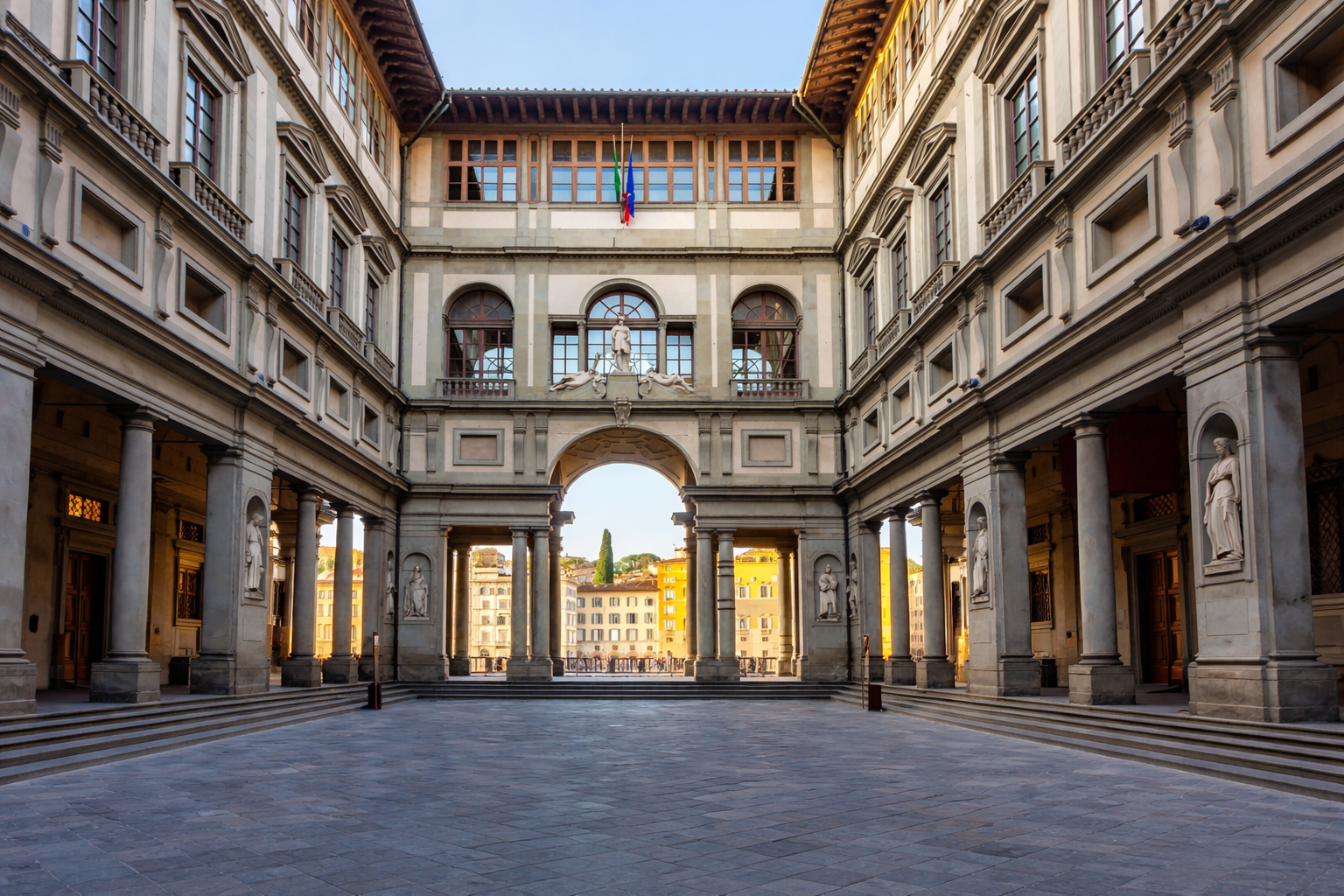
Florence packs more world-changing art and architecture into a walkable historic centre than almost anywhere on earth — the entire core is a UNESCO World Heritage Site, and most of the best things to see in Florence sit within a 20-30 minute stroll of each other. This guide counts down the top 15 attractions, with what each one is, why it matters, and one practical tip verified for 2026. Whether you have one day or three, use it to build a smart, crowd-beating plan for your visit.
Florence's Top 15 Attractions
1. The Duomo & Brunelleschi's Dome
The Cathedral of Santa Maria del Fiore is Florence's beating heart, crowned by Filippo Brunelleschi's terracotta dome (1420-1436) — still the largest masonry vault ever built. The complex also includes Giotto's Campanile (414 steps), the Baptistery with its gilded Gates of Paradise, and the Opera del Duomo Museum. Practical tip: Entering the cathedral itself is free, but the dome climb requires the Brunelleschi Pass (€30, valid 3 days) with a mandatory timed slot that sells out weeks ahead in high season. Book early and arrive 15 minutes before your slot.
2. Uffizi Gallery
The Uffizi is one of the world's greatest art museums, home to Botticelli's Birth of Venus and Primavera, Leonardo's Annunciation, Caravaggio's Medusa, and Michelangelo's Doni Tondo across roughly 100 rooms. It is Italy's second most-visited museum, so the walk-up queue can swallow 60-90 minutes from April to October. Practical tip: Standard admission is €25 walk-up or €29 booked online in advance, but a new afternoon ticket drops the price to €16 on-site (€20 online) for entry from 4pm onward. See our Uffizi Gallery tickets and opening hours guides, or our full Uffizi Gallery highlights guide for the masterpieces to prioritize.
3. Accademia Gallery (Michelangelo's David)
The Galleria dell'Accademia exists in the popular imagination for one reason: Michelangelo's David (1501-1504), the marble colossus that is arguably the most famous sculpture on earth. The approach through the Prigioni ("Prisoners") — figures Michelangelo left half-emerging from the stone — is unforgettable. Practical tip: Adult admission is €16 at the door or €20 online. Timed slots sell out weeks ahead in summer — pre-book a skip-the-line David ticket. Not sure where to find him? See where is Michelangelo's David, or our full Accademia Gallery guide.
4. Ponte Vecchio
Florence's iconic medieval bridge has spanned the Arno since 1345 and is famously lined with goldsmiths' and jewellers' shops jutting over the water — the only Florentine bridge to survive World War II intact. Above the shops runs the Vasari Corridor. Practical tip: Crossing and window-shopping the bridge is completely free. For the classic photograph, walk to the neighbouring Ponte Santa Trinita, and visit early morning to beat the crowds.
5. Piazza della Signoria & Palazzo Vecchio
This open-air sculpture gallery is Florence's civic living room, dominated by the crenellated Palazzo Vecchio (city hall since 1299) and its 94-metre Arnolfo Tower. The adjacent Loggia dei Lanzi displays masterpieces including Cellini's bronze Perseus — all free to admire outdoors. Practical tip: The square and Loggia are free; the museum runs around €19 and the Arnolfo Tower climb (233 steps, no lift) around €12.50. Tower slots are limited — book ahead.
6. Piazzale Michelangelo
This panoramic terrace on the south bank offers the postcard view of Florence — the whole city spread below with the Duomo, Ponte Vecchio and Tuscan hills beyond. It's the classic sunset spot, and it costs nothing. Practical tip: Entirely free. Come 45-60 minutes before sunset to claim a spot on the wall, and consider walking up via the Rose Garden rather than taking the bus.
7. Boboli Gardens & Pitti Palace
Across the Arno, the monumental Pitti Palace was the Medici grand-ducal residence and now houses the Palatine Gallery (Raphael, Titian, Rubens, Caravaggio). Behind it rise the Boboli Gardens, a 16th-century masterpiece of Italian landscape design. Practical tip: A combined Pitti Palace + Boboli Gardens ticket is €22 same-day or €25 in advance. Boboli, unlike the museums, opens daily including Mondays.
8. Basilica di Santa Croce
Known as the "Temple of the Italian Glories," this vast Franciscan basilica holds nearly 300 tombs, including those of Michelangelo, Galileo and Machiavelli, plus a cenotaph to Dante and Giotto's frescoes in the Bardi Chapel. Practical tip: The full adult ticket is €10 and covers the basilica, both cloisters and the Pazzi Chapel. Note the dress code — shoulders and knees covered.
9. Medici Chapels (Michelangelo's New Sacristy)
Attached to the Basilica of San Lorenzo, the Cappelle Medicee are the mausoleum of the dynasty that funded the Renaissance. The showpiece is Michelangelo's New Sacristy, with his allegorical sculptures of Dawn, Dusk, Night and Day. Practical tip: Admission is €11, free on the first Sunday of the month. The weekly closing day changed from Tuesday to Monday from mid-March 2026 — many guidebooks still list the old schedule.
10. Bargello Museum
Housed in Florence's oldest public building, the Bargello holds the world's finest collection of Renaissance sculpture, including Donatello's revolutionary bronze David and Michelangelo's early Bacchus. It's far quieter than the Accademia. Practical tip: Full admission is €12. A combined Accademia + Bargello 48-hour ticket costs €26 — excellent value for sculpture lovers.
11. Vasari Corridor
Reopened on 21 December 2024 after eight years closed, this roughly 750-metre elevated passageway was built by Giorgio Vasari in 1565 so the Medici could walk unseen from Palazzo Vecchio to the Pitti Palace. It runs through the Uffizi and over the Ponte Vecchio, restored to its bare 16th-century simplicity. Practical tip: Access is via a combined Uffizi + Vasari Corridor ticket (€47 online, €43 at the window), walked one direction only in groups of up to 25 — slots sell out fast. See our full Vasari Corridor tickets & tours guide before you book.
12. Mercato Centrale
Florence's central market is a cast-iron-and-glass hall from 1874. The ground floor is a working food market, while the buzzing first-floor food hall serves fresh Tuscan specialities from morning to midnight. Practical tip: Free to wander. The ground-floor market runs Monday-Saturday roughly 7am-2pm; the upstairs food court is open daily 10am to midnight.
13. Oltrarno & Santo Spirito
Cross the Arno to the Oltrarno, Florence's most authentic quarter, a warren of artisan workshops around Santo Spirito and San Frediano. Piazza Santo Spirito, fronted by Brunelleschi's last church, is the social heart, sleepy by day and lively at aperitivo hour. Practical tip: Wandering is free. Many workshops close for lunch (roughly 1-3:30pm), so browse in the morning or late afternoon, then stay for dinner.
14. San Miniato al Monte
Perched on the hill above Piazzale Michelangelo, this 11th-century Romanesque basilica is one of the most beautiful — and most overlooked — churches in Florence, with a geometric marble façade and a 13th-century golden apse mosaic. Practical tip: Entry is free. Time your visit for late afternoon to hear the monks' Gregorian chant and then catch sunset — the view from here is even calmer than the Piazzale below.
15. Brancacci Chapel
Inside Santa Maria del Carmine in the Oltrarno, the Brancacci Chapel holds Masaccio's Stories of St Peter fresco cycle — a foundational work of the Renaissance later studied closely by Michelangelo. Practical tip: The full adult ticket is €10, with mandatory advance reservation and visits capped at 10 people for about 30 minutes. Closed Tuesdays.
Free Things to Do in Florence
Florence rewards budget travellers generously. The best free things to see include the panorama from Piazzale Michelangelo and the hilltop San Miniato al Monte; the open-air sculptures of the Loggia dei Lanzi and Piazza della Signoria; window-shopping along the Ponte Vecchio; and wandering the artisan lanes of the Oltrarno. The Cathedral itself is free to enter, as are many churches including Santo Spirito. Best of all, on the first Sunday of every month the state-run Domenica al Museo scheme makes the Uffizi, Accademia, Pitti, Boboli, Bargello and Medici Chapels free for everyone — though queues are the longest of the month, so arrive at opening.
How Many Days Do You Need in Florence?
Most visitors find 2-3 days ideal for the highlights. With one day, focus on the big three — the Duomo, the Uffizi and the Accademia — plus a walk through Piazza della Signoria and across the Ponte Vecchio, ending at Piazzale Michelangelo for sunset; our one-day Florence guide shows how to sequence it. With two to three days, add Santa Croce, the Bargello, the Medici Chapels, the Oltrarno and the Pitti Palace at a relaxed pace. If you have a fourth day, take a day trip: Pisa (about 1 hour by train) for the Leaning Tower, Siena (about 75 minutes by bus) for its medieval Campo, or the Chianti wine country by guided tour.
Best Time to Visit Florence & Beat the Crowds
The low season runs November to March, when crowds thin, hotel rates drop and you can enjoy the Uffizi and Accademia with far shorter queues — just pack for cool, sometimes rainy weather. The shoulder months of late March-April and late September-October offer the best balance of pleasant weather and manageable crowds. Whatever the season, the golden rules are the same: visit museums right at opening (8:15am), because day-trippers typically arrive between 10am and noon, and save Piazzale Michelangelo for sunset.
Booking Tips: Which Florence Attractions Need Advance Tickets
Some Florence sights genuinely require — or strongly reward — advance timed tickets, especially April to October:
- Uffizi Gallery — pre-book to skip a 60-90 minute walk-up queue; slots can sell out days ahead in peak season.
- Accademia (David) — timed slots sell out weeks ahead in summer; booking is essential.
- Brunelleschi's Dome climb — the timed dome slot is mandatory and books out weeks in advance.
- Vasari Corridor — small group sizes mean slots vanish fast; book as early as possible.
- Brancacci Chapel — reservation is mandatory due to strict group-size limits.
Palazzo Vecchio's tower, the Medici Chapels and the Bargello are also worth reserving in high season but rarely sell out the way the top sights do. Booking timed tickets doesn't skip the security screening, so still arrive 10-15 minutes before your slot.
Things to See in Florence FAQ
What is Florence famous for? Florence is famous as the birthplace of the Renaissance — the city of the Medici, Michelangelo, Botticelli, Leonardo and Brunelleschi. It's renowned for the Duomo, the Uffizi Gallery, Michelangelo's David, the Ponte Vecchio, and its leather, gold and artisan crafts.
Is Florence walkable? Yes — remarkably so. The historic centre is compact and largely pedestrian, and virtually every major sight is within a 20-30 minute walk. Comfortable shoes matter more than public transport here. If you want a practical route rather than just the short answer, see our Florence walking tours guide.
Can you see Florence in one day? You can see the highlights — the Duomo exterior, the Uffizi, the Accademia, Piazza della Signoria and the Ponte Vecchio — in a single well-planned day with pre-booked tickets, but 2-3 days lets you enjoy it without rushing.
Do you need to book Florence museums in advance? For the Uffizi, Accademia, dome climb, Vasari Corridor and Brancacci Chapel, yes — advance timed tickets are essential or mandatory, especially in high season. Smaller museums can often be visited on the day, particularly in winter. See our Uffizi Gallery tickets guide to get started.
Worth Adding to Your Itinerary
Most first-time visitors build their Florence trip around the Uffizi Gallery and the Accademia Gallery, home to Michelangelo's David — a combined Uffizi and Accademia tour handles the timing for both in a single day. Once you've covered the essentials, the reopened Vasari Corridor above the Ponte Vecchio is the natural next stop, along with a small-group Florence walking tour through Piazza della Signoria and the Duomo, and day trips to Pisa, Siena, San Gimignano and the Chianti wine region. The live options below update automatically for Florence experiences and skip-the-line tickets.