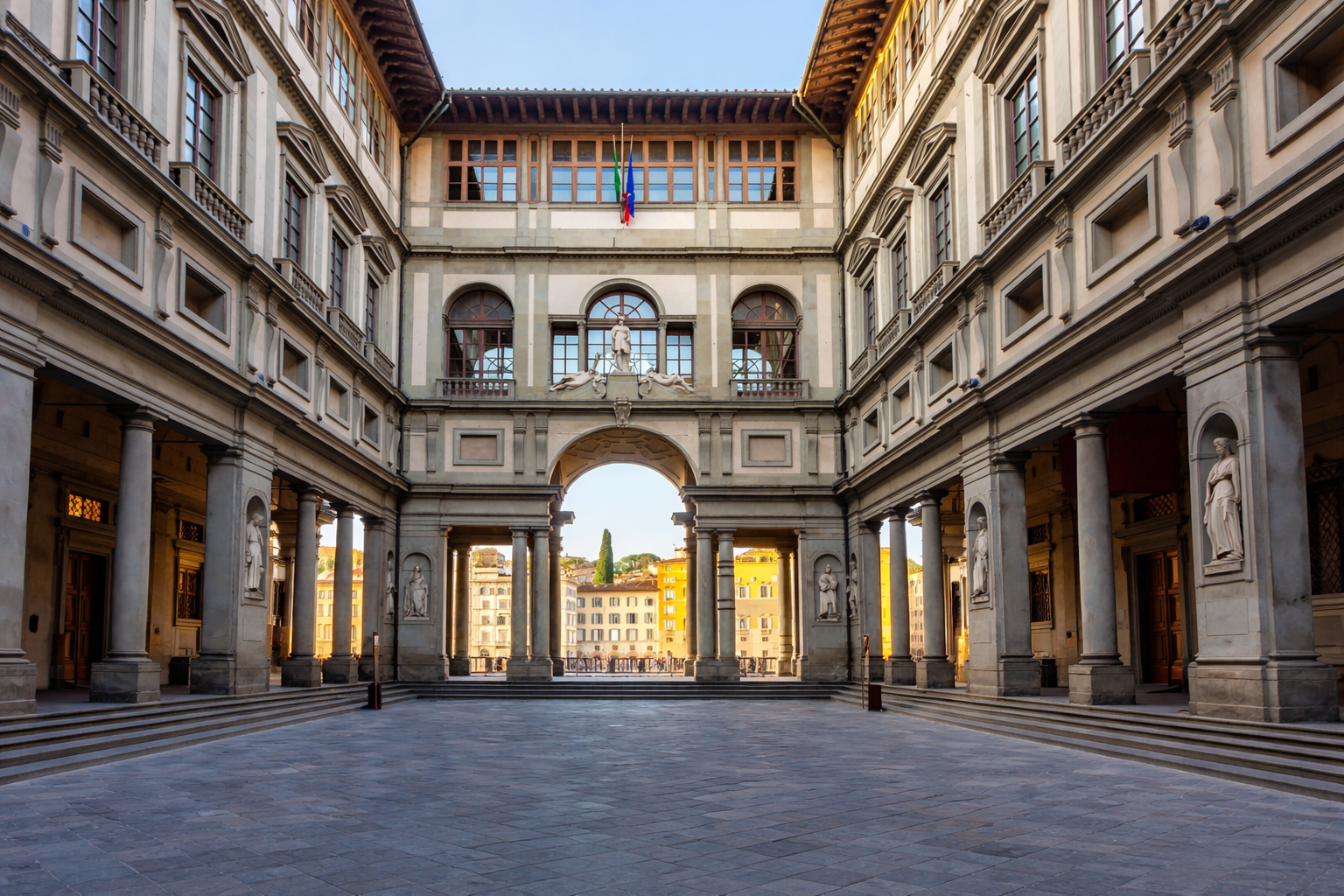
The Uffizi Gallery in Florence holds one of the greatest concentrations of Renaissance art on earth, and its single most famous painting is Sandro Botticelli's Birth of Venus. Whether you have two hours or a full day, this guide walks you through the Uffizi masterpieces you cannot miss, with current 2026 room locations, what to look for in each work, a suggested route, and practical advice on tickets and skip-the-line booking.
Built as Medici administrative offices in the 1560s (the word uffizi means "offices"), the gallery today spans 101 rooms across its floors and is one of the busiest museums in the world — it welcomed 5,294,968 visitors in 2024, making it Italy's second most-visited state museum. The collection was handed to the people of Florence by the last Medici heiress, Anna Maria Luisa de' Medici, in 1737, ensuring these treasures would never leave the city.
Planning note: The Uffizi is in the middle of a multi-year reorganization launched by director Simone Verde, who took over in January 2024. Room numbers can shift, and the museum now uses two systems at once — legacy plain numbers on maps and signage (e.g., Room 35, Room 83) and newer alphanumeric codes on the official website (e.g., A35, D22). Follow the in-museum signage and artwork labels, and check uffizi.it before you go.
Botticelli's Birth of Venus: The Uffizi's Most Famous Painting
If there is one work everyone comes to see, it is Botticelli's Birth of Venus (Nascita di Venere). Painted around 1484–1485, it depicts the goddess Venus arriving on shore, standing on a giant scallop shell, having emerged fully grown from the sea. It is one of the most recognized images in all of Western art — so iconic that the European Central Bank chose it for currency: the Italian 10-cent euro coin, minted since 2002, shows a detail from the painting.
Where to see it: The Botticelli rooms on the second floor (long known as Rooms 10–14, "Botticelli Hall"). After a renovation that closed the rooms in late 2025, the Uffizi unveiled a brand-new permanent installation on 16 June 2026. For the first time, the Birth of Venus and Primavera are displayed facing one another in adjoining spaces — two rooms that together contain 16 works by Botticelli, with walls repainted in a soft "Renaissance grey." Director Simone Verde said the redesigned galleries "seek to present visitors with the Uffizi of the future." Crucially, both paintings are now housed in airtight, state-of-the-art display cases — the large external protective glass panels that used to sit between visitors and the works have been removed, giving a far clearer view.
What to look for:
- The Venus Pudica pose. Venus covers herself with one hand and her flowing golden hair with the other, echoing an ancient "Modest Venus" statue type. Her elongated, idealized body follows an ideal of beauty derived from classical philosophy, not from anatomical realism.
- The winds and the roses. On the left, the wind gods Zephyr and Chloris (sometimes identified as Aura) blow Venus to shore amid a shower of pink roses.
- The waiting attendant. On the right, an Hour of Spring (one of the Horae) reaches out with a flower-covered cloak to wrap the goddess.
- The technique. Unlike most Renaissance panel paintings, this is painted in tempera on canvas — a cheaper, lighter support then favored for decorative works in country villas. The luminous flesh tones and the delicate modeling reward standing close.
- Neoplatonic meaning. The painting is steeped in the Neoplatonic philosophy of Lorenzo de' Medici's circle, in which physical beauty was a reflection of divine beauty. It was most likely commissioned by Lorenzo di Pierfrancesco de' Medici, a cousin of Lorenzo the Magnificent — though the Uffizi cautions that no documents survive linking it to the family before Vasari's 1550 account.
In the new hang, the Birth of Venus is flanked by two of Botticelli's circular Madonnas — the Madonna of the Magnificat and the Madonna of the Pomegranate — deliberately paired to highlight the resemblance between Venus and the Virgin Mary.
Because Botticelli Hall is the most crowded room in the museum, plan to arrive at opening or in the late afternoon; between roughly 10 a.m. and 2 p.m. it can be shoulder-to-shoulder.
Botticelli's Primavera (Allegory of Spring)
Botticelli's other monumental mythological painting, Primavera ("Spring"), was painted a few years earlier, around 1480–1482, and hangs opposite the Birth of Venus in the redesigned Botticelli rooms. It is a panel painting (on wood), slightly larger than the Birth of Venus, and arguably even more sophisticated in its symbolism.
What to look for: A dreamlike orange grove peopled by mythological figures — Venus at the center, the Three Graces dancing, Mercury reaching up to the clouds, and, on the right, the wind Zephyr seizing the nymph Chloris, who transforms into Flora, the flower-strewn goddess of spring. The meadow is a botanical marvel: studies (notably Mirella Levi D'Ancona's classic 1983 catalogue) have counted hundreds of plant species scattered across it, with well over a hundred flowers identifiable to species. In the new installation, Primavera is flanked by the Madonna of the Rose Garden and the Madonna of the Cherubim, continuing the dialogue between classical and Christian imagery.
The same Botticelli rooms also hold his Adoration of the Magi — which contains portraits of several Medici and a self-portrait of the artist — plus Pallas and the Centaur, the Calumny of Apelles, and a detached fresco of the Annunciation from the church of San Martino.
Leonardo da Vinci: The Annunciation and the Adoration of the Magi
Leonardo da Vinci is represented at the Uffizi by three early works, all displayed together in the Leonardo room — Room 35 on the second floor (officially coded A35 on the museum's website). Note that some older guides still call this "Room 15," an outdated number from before the 2018 reinstallation.
- The Annunciation (c. 1472–1475). Painted when Leonardo was in his early twenties, this shows the Archangel Gabriel appearing to the Virgin Mary in a beautifully observed outdoor setting. Look at the angel's wings and the meticulous rendering of plants and light — early evidence of Leonardo's scientific eye.
- The Adoration of the Magi (1481). An ambitious, unfinished composition Leonardo abandoned when he left for Milan. Recently restored, it offers a fascinating look at how he planned and built up a painting.
- The Baptism of Christ (c. 1475). A collaboration between Leonardo and his master Andrea del Verrocchio; Leonardo is credited with the softly modeled angel on the left, said to have astonished Verrocchio.
Worth Adding to Your Itinerary
Most travelers pair the Uffizi with the rest of Renaissance Florence. If you have another day, the Accademia Gallery holds Michelangelo's David a 15-minute walk north, and combined Uffizi and Accademia tours handle the timing for both. Art lovers should look at the reopened Vasari Corridor above the Ponte Vecchio, a small-group Florence walking tour through Piazza della Signoria and the Duomo, and day trips to Pisa, Siena, San Gimignano and the Chianti wine region. The live options below update automatically for Florence experiences and skip-the-line tickets.
Michelangelo's Doni Tondo
Michelangelo considered himself a sculptor first, so the Doni Tondo (Holy Family, c. 1506–1508) is precious: it is his only finished panel painting and the only Michelangelo painting in Florence. It is displayed in the combined Raphael-and-Michelangelo room, officially coded A38 (sometimes signed as Room 41; older sources place it near the Leonardo room in Room 35).
What to look for: The vivid, almost electric colors — pinks, blues, acid greens — that startled restorers and are entirely original. Mary, Joseph and the infant Christ twist together in a complex spiral ("serpentine") composition, while nude figures in the background echo the recently rediscovered Hellenistic Laocoön sculpture. The original round frame, carved with five protruding heads, is part of the artwork.
One thing the Doni Tondo is not: the famous marble David. That statue is a short walk away at the Accademia — see our guide on where Michelangelo's David is and book a David skip-the-line ticket if you want to see both in one day.
Raphael's Madonna of the Goldfinch
Raphael painted the Madonna of the Goldfinch (Madonna del Cardellino) around 1505–1506 during his formative years in Florence, when he was absorbing the lessons of both Leonardo and Michelangelo. It hangs in the same Raphael-and-Michelangelo room (A38), alongside Michelangelo's Doni Tondo and Raphael's paired portraits of Agnolo Doni and Maddalena Strozzi. (Raphael was formerly shown separately in Room 66, a number some guides still cite.)
What to look for: The tender triangular grouping of the Virgin, the infant Christ and the young John the Baptist, who holds a goldfinch. The little bird — with its red facial spot — is a traditional symbol of Christ's future Passion. Raphael's other Uffizi works include his youthful self-portrait and the great group portrait of Pope Leo X.
Titian's Venus of Urbino
The most famous nude of the Venetian Renaissance, Titian's Venus of Urbino (1538), hangs in the Titian room — Room 83 (official code D22) on the first floor. Commissioned by Guidobaldo II della Rovere, Duke of Urbino, it shows a nude young woman reclining on rumpled sheets in a lavish Venetian interior, gazing directly and confidently at the viewer.
What to look for: The frank, unashamed gaze; the sleeping dog at her feet (a symbol of fidelity); the maidservants rummaging in a cassone (marriage chest) in the background; and the pot of myrtle on the windowsill, a plant associated with Venus and lasting love. The painting is generally read as a celebration of marriage and marital love. It directly inspired later masterpieces including Manet's Olympia. In A Tramp Abroad, Mark Twain notoriously called it "the foulest, the vilest, the obscenest picture the world possesses" — he was wrong, but it shows how provocative the image has always been.
Caravaggio's Medusa and Bacchus
For sheer drama, head to the Caravaggio room — Room 90 on the first floor (officially D29, "Caravaggio and Artemisia"). Three of the artist's most important works hang here:
- Medusa (c. 1597). Painted on a convex ceremonial shield, it shows the Gorgon's severed head at the instant of death, mouth open in a scream, snakes writhing in her hair. Caravaggio painted the convex surface to look concave, so the head seems to project toward you. It was created as a gift for Grand Duke Ferdinando I de' Medici.
- Bacchus (c. 1598). The god of wine as a slightly drunk, bare-shouldered young man offering you a glass, with rotting fruit on the table — mythology brought down to earth. Look closely at the wine carafe for a tiny reflected self-portrait of the artist.
- The Sacrifice of Isaac (c. 1603). The terrifying instant before Abraham's knife falls, stopped by the angel's hand.
Caravaggio's revolutionary use of dramatic light emerging from darkness (chiaroscuro/tenebrism) changed European painting forever.
Artemisia Gentileschi's Judith Slaying Holofernes
In the same Caravaggio-and-Artemisia room (Room 90 / D29) hangs one of the most powerful paintings in the museum: Artemisia Gentileschi's Judith Slaying Holofernes. Artemisia was the most celebrated female painter of the Baroque era, and her visceral, blood-spattered depiction of the biblical heroine beheading the Assyrian general is often read through the lens of her own biography, including the sexual violence she survived as a young woman. This version was painted for Cosimo II de' Medici. (Don't confuse it with her Judith and Her Maidservant, which is across the river at the Pitti Palace.)
Giotto's Ognissanti Madonna
The Uffizi's second-floor journey begins with a room of giant altarpieces where you can watch the Renaissance being born. Room 2 (Giotto and the 13th century) displays three monumental Maestà (Madonna Enthroned) paintings side by side: Cimabue's Santa Trinita Maestà, Duccio's Rucellai Madonna, and Giotto's Ognissanti Madonna (c. 1310).
What to look for: Compare the three. Giotto's Madonna has real weight and volume, sits in a convincingly three-dimensional throne, and shows genuine human emotion — a decisive break from the flat, gilded Byzantine tradition. Without Giotto, the Renaissance as we know it might never have happened.
Piero della Francesca's Duke and Duchess of Urbino
In the early-Renaissance rooms (Room 8) hangs Piero della Francesca's double portrait of Federico da Montefeltro, Duke of Urbino, and his wife Battista Sforza, painted around 1473–1475.
What to look for: The two figures face each other in strict profile — a format borrowed from ancient coins — against a continuous, luminous landscape. Federico is always shown from the left because he had lost his right eye and broken his nose in a tournament. The panels are painted on both sides: the reverse shows the couple riding triumphal chariots accompanied by allegorical Virtues. Battista died at just 26, and some scholars believe the diptych was painted, at least in part, as a memorial.
Other Uffizi Masterpieces Worth Seeking Out
- Paolo Uccello, The Battle of San Romano (c. 1435–1440) — a dazzling early experiment in perspective; two companion panels are in the Louvre and London's National Gallery.
- Gentile da Fabriano, Adoration of the Magi (1423) — the gorgeous high point of International Gothic.
- Filippo Lippi, Madonna and Child with Two Angels — Botticelli's teacher, and the model for his Madonnas.
- The Tribuna — Buontalenti's octagonal, mother-of-pearl-domed room of 1584, home to the ancient Medici Venus sculpture.
- The First Corridor — lined with ancient Roman busts and statues from the Medici collection, with superb views over Piazza della Signoria and the Arno.
What to See at the Uffizi in 2–3 Hours: Suggested Itinerary
You cannot see everything, and you shouldn't try — museum fatigue is real. For a focused highlights visit, follow the chronological route on the second floor, then drop to the first floor for the Baroque:
- Room 2 — Giotto's Ognissanti Madonna (10 min). The birth of the Renaissance.
- Rooms 5–8 — Gentile da Fabriano, Paolo Uccello, Piero della Francesca (15 min).
- Botticelli rooms — Birth of Venus & Primavera (30–35 min). Go here first thing if you arrive at opening, before the tour groups.
- Room 35 — Leonardo da Vinci (15 min). Annunciation, Adoration of the Magi, Baptism of Christ.
- Room A38 (aka 41) — Michelangelo's Doni Tondo & Raphael's Madonna of the Goldfinch (15 min).
- Pause at the panoramic terrace café above the Loggia dei Lanzi for views of Palazzo Vecchio (10–15 min).
- Room 83 — Titian's Venus of Urbino (10 min).
- Room 90 — Caravaggio's Medusa & Bacchus, plus Artemisia's Judith (20 min).
Allow 2 hours for a brisk highlights tour, 3 hours for a comfortable one, and 4+ hours if you want to linger and explore the first-floor Northern European and Venetian rooms. For a fuller plan, see our Uffizi one-day guide.
Practical Info: Hours, Tickets & Skip-the-Line Booking (2026)
Opening hours. The Uffizi is open Tuesday to Sunday, 8:15 a.m. to 6:30 p.m., with last entry strictly enforced at 5:30 p.m. It is closed every Monday, and on 1 January and 25 December. Staff begin clearing the rooms from about 6 p.m., so arrive at least two hours before closing for a meaningful visit. For the latest schedule see our Uffizi Gallery hours page.
Ticket prices (2026). The standard adult ticket is €25 at the museum window or €29 booked online in advance (plus a booking fee). A new afternoon ticket introduced on 1 January 2026 drops the price to €16 on-site (€20 online) for entry from 4 p.m. onward. EU citizens aged 18–25 pay a reduced €2, and under-18s of any nationality enter free (bring ID). A combined 5-day pass covers the Uffizi, Pitti Palace and Boboli Gardens.
Free entry. Admission is free on the first Sunday of every month under Italy's Domenica al Museo program (2026 dates include January 4, February 1, March 1, April 5, May 3, June 7, and monthly thereafter) — but no reservations are possible, and queues can run for hours in peak season. Unless you're on a tight budget with time to spare, a paid ticket on a quiet weekday is a far better experience.
Skip-the-line / timed entry. There is no separate "skip-the-line" door at the Uffizi — everyone passes through the same security check. What a pre-booked, timed-entry ticket buys you is a much shorter queue: in high season the walk-up line can be very long while the reserved-ticket line moves quickly. This is why booking a timed ticket in advance is essential from roughly April through October, when day-of tickets frequently sell out. See our Uffizi Gallery tickets page to book advance skip-the-line entry.
Best times to visit. The 8:15 a.m. opening slot is the single best time — you can have Botticelli Hall almost to yourself for the first half hour. The 4 p.m. afternoon slot is the second-best (and cheaper). Tuesday, Wednesday and Thursday mornings are the quietest; weekends and the free first Sunday are the busiest. Photography without flash is allowed throughout.
Uffizi Gallery FAQ
What is the most famous painting in the Uffizi? Botticelli's Birth of Venus is the Uffizi's most famous painting and its single biggest draw, closely followed by his Primavera. Both hang in the newly redesigned Botticelli rooms on the second floor.
Is the Birth of Venus in the Uffizi? Yes. Botticelli's Birth of Venus has been in the Uffizi Gallery since the 19th century and is one of its centerpiece works, displayed in the Botticelli rooms (historically Rooms 10–14).
Is Michelangelo's David in the Uffizi? No — this is the most common Florence mix-up. Michelangelo's David is at the Accademia Gallery, not the Uffizi. The Uffizi's only Michelangelo is the painted Doni Tondo. To see the statue, read our guide on where Michelangelo's David is and book a David skip-the-line ticket.
How long do you need at the Uffizi? Plan on 2 hours for the highlights, 3 hours for a relaxed visit, and 4+ hours if you're an art lover who wants to explore beyond the star attractions.
Do I need to book Uffizi tickets in advance? From April to October, yes — day-of tickets regularly sell out and the walk-up queue can be very long. In winter you can often walk up on a weekday morning, but advance timed tickets always save time.
What else can I see near the Uffizi? The gallery sits between Piazza della Signoria and the Arno, a short walk from the Ponte Vecchio, Palazzo Vecchio and the Duomo — easy to combine into one day in central Florence. If you want the whole Renaissance in a single day, pair it with the Accademia Gallery and Michelangelo's David. For the rest of the city's essential sights, see our guide to the top things to see in Florence.
Whichever masterpieces top your list, book a timed skip-the-line ticket, arrive early, and give yourself time to stand quietly in front of the Birth of Venus — no reproduction matches the real thing.