The Uffizi Gallery is one of the world's great art museums — and also one of its busiest. It welcomed 5,294,968 visitors in 2024, ranking as Italy's second most-visited state museum after the Colosseum. A little planning transforms the experience from an exhausting shuffle through crowds into an unforgettable encounter with Botticelli, Leonardo, Michelangelo and Caravaggio. This guide walks you through the Uffizi's layout, the best time to visit, how long to allow, what to wear, and exactly what to expect at the entrance and inside.
Once you have read this, you will want to sort your Uffizi Gallery tickets and double-check the current opening hours before you go.
Uffizi Gallery Map: How the Museum Is Laid Out
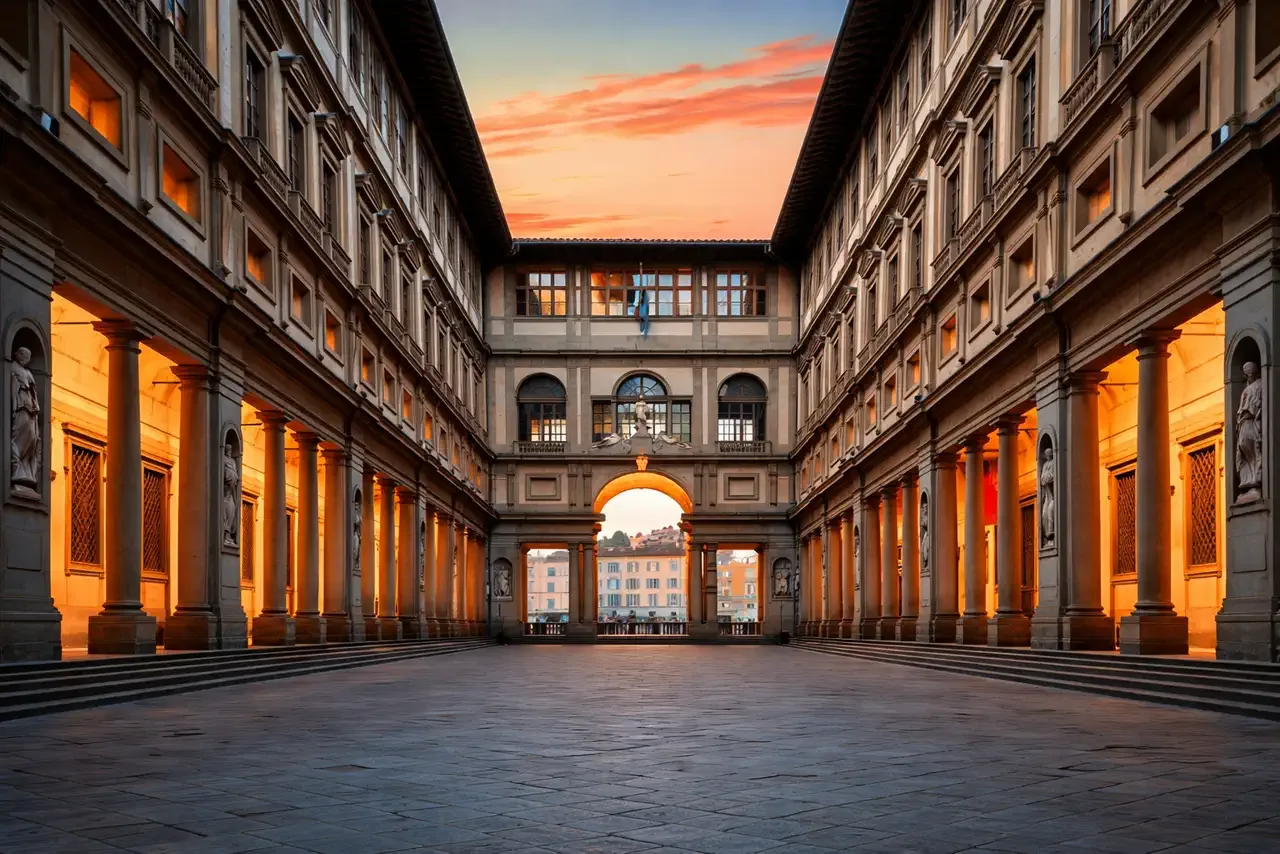
The Uffizi occupies a distinctive U-shaped Renaissance building designed by Giorgio Vasari between 1560 and 1580, running right down to the Arno River. Understanding this simple shape is the key to reading any Uffizi gallery map or floor plan: two long parallel wings (the East and West corridors) are joined at the river end by a short third corridor with windows overlooking the Arno and the Ponte Vecchio. The gallery's roughly 1,500 works are displayed across 101 rooms on two exhibition floors.
Where you start: the second floor. You enter on the ground floor, then climb Vasari's grand 16th-century staircase (or take a lift) up to the second floor, which holds the heart of the collection. Here the rooms run in a roughly chronological sequence, telling the story of Western painting from medieval and Byzantine panels (Giotto, Cimabue, Duccio) through the early Renaissance (Lippi, Piero della Francesca) to the High Renaissance masters. This is where you will find the famous Botticelli rooms (the Birth of Venus and Primavera), Leonardo da Vinci's Annunciation, Michelangelo's Doni Tondo, and Raphael's Madonna of the Goldfinch. The three corridors lining the U-shape are hung with ancient Roman sculptures and busts from the Medici collection — most visitors rush past them, but they are worth slowing down for.
Then descend to the first floor. After the second floor, a staircase brings you down to the first floor, modernised under the ongoing “New Uffizi” project. This level houses the Mannerist and Baroque collections — Caravaggio's Medusa and Bacchus, Titian's Venus of Urbino, and rooms of Dutch, Flemish, Spanish and French masters including Rubens and Rembrandt. Temporary exhibitions are usually staged here and are included in your ticket.
The flow through the museum is largely one-directional: up to the second floor, through the chronological rooms, down to the first floor, and out via the ground-floor bookshop and exit. Because of this, you generally cannot backtrack easily — and you cannot re-enter once you leave.
The rooftop terrace. At the end of the second floor, above the Loggia dei Lanzi, sits the Caffetteria (the terrace café), with an outdoor terrace commanding a spectacular view of the Palazzo Vecchio and the Florence skyline. It is the natural halfway pause point before you head down to the first floor. Free museum maps are available at the entrance after security — grab one, as room numbering can shift during renovations. If you want a room-by-room walking order rather than a floor plan, our Uffizi highlights guide sets one out.
Worth Adding to Your Itinerary
Most people planning an Uffizi morning are also deciding what fills the rest of the day. The usual companions are the Accademia Gallery for Michelangelo's David, the Duomo and Brunelleschi's dome ten minutes north, the Vasari Corridor running from the Uffizi across the Ponte Vecchio, and the Palazzo Vecchio on Piazza della Signoria, right outside the gallery's own courtyard. Guides who cover the Uffizi frequently cover those too, often in the same booking. The live options below update automatically for Florence tours and museum experiences.
Best Time to Visit the Uffizi
Timing your visit well makes an enormous difference. The single best strategy is to arrive right at opening, 8:15 a.m., on a quieter weekday in low season. The difference between 8:15 a.m. on a Wednesday in November and 11 a.m. on a Saturday in July is the difference between having Botticelli almost to yourself and jostling with a wall of raised phones.
Best time of day. The first 90 minutes after opening (8:15–9:45 a.m.) are the calmest — and in high season the museum sells a discounted “Prima Mattina” early-bird ticket (€19 plus the €4 booking fee) for the very first slots, with effective entry no later than 8:55 a.m. The museum gets progressively busier as tour groups, school trips and cruise excursions arrive; as one licensed Florence tour guide puts it, “the most crowded time is around lunchtime, so between 12 and 3 pm,” while planning specialists note that “midday (10am–3pm) is consistently the busiest period, when day-trip coach groups and morning tour groups overlap.” The late afternoon is the second-best window: day-trip groups leave around 3 p.m. and the galleries noticeably calm down. From 1 January 2026 the Uffizi introduced a discounted “Afternoon” ticket: per the official notice, “the admission fee costs 16 €” for visitors entering from 4 p.m. onwards (or €20 if purchased in advance), versus the standard €25 on-site and €29 online. That makes a late-afternoon visit both quieter and cheaper. The trade-off is time: last admission is 5:30 p.m. and rooms begin closing from 6 p.m., so a 4–5 p.m. arrival gives you only one to two hours inside.
Best day of week. Because the Uffizi is closed on Mondays, Tuesday tends to be busy as visitors pile in on the first open day. Wednesday and Thursday are consistently the quietest weekdays. Weekends — especially Saturday — are the busiest. Avoid the first Sunday of the month, when admission is free: it is the single most crowded day, with queues that can run well over an hour and rooms packed shoulder to shoulder. Every free Sunday date for 2026 is listed on our opening hours page.
Best season. November to March is the quietest and cheapest time, with the shortest queues. October is a sweet spot — thinner crowds, pleasant weather and lovely natural light through the Arno-side windows. June, July and August are the busiest and hottest months, when same-day tickets frequently sell out by mid-morning; Easter week is notoriously chaotic. Avoid major Italian public holidays, when crowds swell.
| If you want… | Aim for… | Avoid… |
|---|---|---|
| Fewest crowds | 8:15 a.m. opening, Wed/Thu, Nov–Mar | 10 a.m.–3 p.m.; Saturdays |
| Best value | 4 p.m. afternoon discount ticket (€16 on-site) | First Sunday free days |
| A calmer afternoon | After 4 p.m. (groups have left) | Late arrival if you want a full visit |
| Pleasant weather + light | October | July–August heat and peak crowds |
How Long Do You Need at the Uffizi?
There is no single right answer — it depends on how much of an art lover you are. Here is a realistic breakdown:
- Highlights only (about 2 hours): Enough to see the essential masterpieces — the Botticelli rooms, Leonardo, Michelangelo's Doni Tondo, Raphael, Titian's Venus of Urbino and Caravaggio — following a focused route straight to the big names. This is the minimum most visitors should allow.
- Comfortable visit (about 3 hours): The sweet spot for most people. You can linger in the Botticelli rooms, pause at the Arno-view corridor, take a coffee break on the terrace, and still see the first-floor Baroque galleries without rushing.
- Enthusiast / half day (4+ hours): For serious art lovers. Add the full first floor (Northern European masters, Rubens, Velázquez), the Roman-sculpture corridors, the Niobe Room and the temporary exhibitions. Many enthusiasts happily spend a half or even full day here.
Families with children should plan for less structured time — a curated selection of eight to ten works over 1.5–2 hours usually works far better than attempting everything, since a full visit often exceeds younger children's attention spans. The #UffiziKids initiative offers child-friendly itineraries. Whatever your pace, the Uffizi rewards planning: build your visit into a dedicated Florence day rather than squeezing it between other sights. For a room-by-room route, see our one-day Uffizi guide.
Is the Uffizi worth it? Emphatically yes. It holds the finest collection of Italian Renaissance painting anywhere in the world, and even a focused two-hour visit delivers a run of masterpieces you simply cannot see together anywhere else.
Uffizi Dress Code & What to Wear
There is no strict, formal dress code at the Uffizi in the way that Italian churches enforce covered shoulders and knees. The museum's own rules simply require “clothing which is appropriate to the formal setting of the museum” — meaning no swimwear, no skimpy or beach clothing, and no fancy dress, wedding dresses or costumes. Jeans, smart shorts and normal everyday clothes are all perfectly fine. In short: dress comfortably and reasonably neatly, and you will have no issues.
The practical advice matters far more than the dress code:
- Comfortable shoes are essential. With 101 rooms across two floors and hard stone and marble floors underfoot, you will walk a couple of kilometres and be on your feet for hours. Wear well-broken-in trainers, flats or low, comfortable shoes. There is limited seating.
- Dress in layers. The galleries are climate-controlled for the artworks, so a light sweater or jacket you can add or remove keeps you comfortable year-round.
- Travel light on bags. Large bags, backpacks, umbrellas and bulky objects are not allowed into the galleries and must be left in the cloakroom. Bring only a small crossbody bag or handbag to save time — these are still subject to security screening.
Entrance & Security: What to Expect
Where the Uffizi is. The gallery sits at Piazzale degli Uffizi 6, in the heart of Florence between Piazza della Signoria and the Ponte Vecchio, a short walk from the Duomo and about ten minutes on foot from Santa Maria Novella train station. Everything happens around the Piazzale degli Uffizi, the long courtyard-square formed by the U-shaped building.
Which door to use. The Uffizi's entrances are numbered, and the setup is in transition due to the ongoing “New Uffizi” renovations and a change of ticketing operator in late 2025 — so it is worth confirming on arrival or on the museum's official notices page. Under the long-standing official system, pre-booked and skip-the-line ticket holders first go to Door 3 (on the west side of the Piazzale) to collect or validate their ticket, then proceed to Door 1 to enter and pass through security. Same-day walk-up buyers use the main entrance (Door 2). Groups and school parties have their own designated door. Note that a few 2026 guides now report Door 3 closed with all individuals using Door 1 — a sign of the reconfiguration in progress — so follow the signs and staff in the square. Arrive about 10–15 minutes before your slot.
Nominative tickets and ID. This is the most important 2026 change. Per the official Uffizi notice effective 13 October 2025, “all entrance tickets to the museum complexes of Le Gallerie degli Uffizi will become nominal (personalized)… If the name on the ticket does not match the visitor's ID document, entry will not be allowed. In such cases, no refund will be issued.” You must provide each visitor's full name when booking and bring an original photo ID (passport or ID card) that matches — so book exactly as your ID reads. This applies to everyone, including free-entry children, and each account may buy a maximum of 10 tickets per day.
Security screening. Everyone passes through an airport-style security check with metal detectors and bag inspection. During peak hours this can take 10–20 minutes even with a pre-booked ticket, since a reserved slot lets you skip the ticket queue but not the security line. You may bring a water bottle of up to half a litre; alcohol, corrosive drinks (including cola), knives, sharp objects and any weapons are prohibited.
Bag storage. The free cloakroom is on the ground floor, immediately past the entrances under the eastern colonnade of the courtyard. Umbrellas, cumbersome bags and backpacks must be checked here before you go up. Per the official ticketing operator CoopCulture, “the cloakroom service is free for luggage smaller than the size limit (55x40x20 cm). From May 11, 2026, for bulky items larger than the size limit (suitcases, trolleys, atypical items, etc.)… the cloakroom service is subject to a fee of €2.00.” Remember: no re-entry once you exit, and the bookshop has no separate entrance, so shop before you leave.
Facilities: Restrooms, Café & Terrace, Bookshop, Accessibility
Restrooms. Toilets are located on all floors and are equipped for visitors with disabilities; for the accessible toilet on the second floor you may need to ask staff for the key. There is a dedicated baby pit-stop room (for breastfeeding and changing) near the cafeteria, plus changing tables in the main toilets.
Café and rooftop terrace. The Caffetteria sits on the second floor at the end of the U, on a terrace above the Loggia dei Lanzi with a superb view over Piazza della Signoria and the Palazzo Vecchio. It serves coffee, drinks, sandwiches, salads and some hot dishes, and it is the ideal mid-visit break. Prices are what you would expect from a museum café, and there is a table-service charge if you sit down (visitors report around a €4 cover) — but the view is the real draw.
Bookshop and post office. There are bookshops at both the entrance and the exit, selling multilingual guidebooks, art books and Gallery-inspired gifts. A small post office at the ground-floor exit handles postage and can mail items bought in the shop.
Water and seating. Bring a small (≤0.5 litre) water bottle, as seating and refreshment points inside are limited. Benches are dotted through some rooms but can fill up quickly. Audio guides are available at the entrance for €6 (or €10 for two), on presentation of a valid ID, with delivery until 5 p.m.
Accessibility. The Uffizi is largely wheelchair accessible. Wheelchair users enter via the ramp on Via della Ninna (there is a small 3–4 cm step where assistance may help), and lifts connect the floors — though some are small, so appropriately sized wheelchairs and walkers can be borrowed free of charge at the accessible entrance (no reservation or deposit needed). Visitors with a certified disability, plus one companion, are entitled to free priority admission. Because lift arrangements can change during renovation works, visitors who cannot use stairs should check the museum's accessibility notices or contact staff in advance.
Frequently Asked Questions
Is there a dress code for the Uffizi? There is no strict dress code like the one enforced at Italian churches. The Uffizi only asks that clothing be appropriate to a formal museum setting — no swimwear, beachwear or fancy dress. Everyday clothes, jeans and comfortable shoes are all fine. The key practical tips are comfortable footwear and layers for the climate-controlled interior.
What is the best time to visit the Uffizi to avoid crowds? Arrive at 8:15 a.m. opening, ideally on a Wednesday or Thursday from November to March. Late afternoon (after 4 p.m.) is the second-quietest window and now cheaper thanks to the 2026 €16 afternoon discount ticket. Avoid 10 a.m.–3 p.m., weekends, the first Sunday of the month (free entry), and major Italian holidays.
How long should I spend at the Uffizi? Allow at least 2 hours for the highlights, around 3 hours for a comfortable unhurried visit, and 4+ hours (up to a half day) if you are a keen art lover. Families with young children usually do best with a focused 1.5–2 hour visit.
Can you bring a bag into the Uffizi? Only small bags and handbags are allowed inside, and they go through security screening. Large bags, backpacks, umbrellas and bulky items must be left in the free ground-floor cloakroom (a €2 fee applies from 11 May 2026 to items over 55 × 40 × 20 cm). You may carry a water bottle of up to half a litre.
Is the Uffizi wheelchair accessible? Yes, largely. Enter via the ramp on Via della Ninna, use the lifts between floors, and borrow a free wheelchair or walker at the accessible entrance if needed. Visitors with a certified disability and one companion get free priority access. Check current accessibility notices before visiting, as lift arrangements can change during renovations.