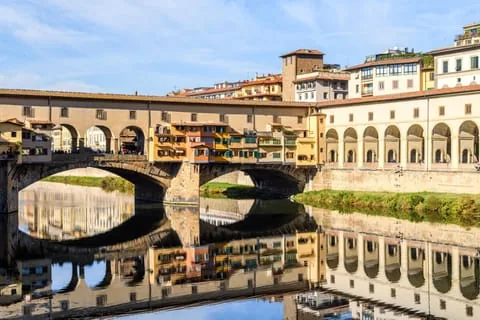
For nearly a decade the Vasari Corridor was Florence's most tantalizing locked door — a kilometre-long Renaissance skywalk sealed behind an unmarked entrance inside the Uffizi. That changed on 21 December 2024, when the corridor reopened to the public after eight years of closure and a major restoration. In 2026 you can once again walk the elevated passage the Medici built to glide, unseen, from Palazzo Vecchio across the Ponte Vecchio to the Pitti Palace. This guide covers what the Vasari Corridor actually is, what you'll see inside after the restoration, and — most importantly — how to get one of the strictly limited tickets before they sell out.
What Is the Vasari Corridor?
The Vasari Corridor (Corridoio Vasariano) is a 16th-century elevated, enclosed passageway that threads through the heart of Florence, connecting the seat of government at Palazzo Vecchio to the Medici family's grand residence at the Pitti Palace on the far bank of the Arno. It was designed by the painter, architect and art historian Giorgio Vasari — the same man who designed the Uffizi itself — and it remains unique in the world.
Grand Duke Cosimo I de' Medici commissioned the corridor in 1565 for the wedding of his son, Francesco I de' Medici, to Joanna of Austria. Cosimo wanted a private, secure route between home and office: Florence had only recently lost its republic, the Medici were not universally loved, and walking the muddy, crowded streets was both undignified and risky. Vasari delivered the entire structure in a remarkable five months, borrowing the concept from the Passetto di Borgo in Rome — the elevated escape route linking the Vatican to Castel Sant'Angelo.
Restoration note: The recent works cost approximately €10-11 million, including a $1 million gift from American entrepreneur Skip Avansino, and began in 2022. The upgrade added lifts, ramps, emergency exits, low-energy LED lighting and, for the first time, climate control.
Roughly 750 metres long (some guides round it up to about a kilometre once you include the internal stretches), the corridor begins at Palazzo Vecchio, joins the Uffizi, runs along the Arno, crosses the river on top of the Ponte Vecchio, bends around the medieval Torre de' Mannelli, passes over the church of Santa Felicita and finally arrives at the Pitti Palace beside the Boboli Gardens. Because it links political power to private residence, it has long been nicknamed the "Medici Corridor" — the ultimate symbol of a dynasty that could quite literally walk above its own citizens.
The Route: From Palazzo Vecchio to the Boboli Gardens
Part of the magic of the corridor is the sequence of buildings and views it strings together. Here is what the route passes over and through, following the direction visitors walk today (from the Uffizi toward Pitti):
- The Uffizi. The corridor branches off the western arm of the gallery. The official entrance for visitors today is inside the Uffizi at the Room D19 meeting point, beside the small Venetian Chapel.
- Along the Arno. Leaving the Uffizi, the passage runs above the Lungarno degli Archibusieri, hugging the north bank of the river with round and rectangular windows framing the water.
- Over the Ponte Vecchio. This is the showstopper. The corridor runs along the top of Florence's famous medieval bridge, directly above the goldsmiths' shops, offering a view down the Arno toward the Ponte Santa Trinita that almost no one else in the city gets to see.
- Around the Torre de' Mannelli. When the Mannelli family refused to let Vasari demolish their medieval tower, the architect simply bent the corridor around its exterior on stone brackets — a visible "kink" that still testifies to one family's stubbornness.
- Above Santa Felicita. On the Oltrarno side, the corridor passes over the loggia of the church of Santa Felicita, where the Medici had a private balcony that looked directly into the nave, letting the family attend Mass without mingling with the congregation below.
- Into the Pitti Palace and Boboli Gardens. The route ends near the Buontalenti Grotto in the Boboli Gardens, from where visitors are escorted out through the courtyard of the Pitti Palace.
What You'll See Inside Today
Here is the single most important thing to understand before you book: the Vasari Corridor you visit today is not the "portrait gallery" of old. From 1973 until its 2016 closure, the corridor was lined with the Uffizi's celebrated self-portrait collection — over 2,000 paintings, sculptures and drawings. During the restoration, that collection was rehoused inside the Uffizi proper, where twelve new first-floor rooms display 255 of the works in proper climate control and lighting. So the corridor reopened in its "original bareness," celebrated for the walk, the architecture and the windows rather than for hanging art.
What you can see today:
- The views and the windows. In its new role as a panoramic promenade, the corridor's windows have been reopened so visitors can take in the historic centre from a genuinely unique vantage point.
- Roman busts over the Ponte Vecchio. In July 2025 the Uffizi installed a collection of ancient Roman imperial busts along the Ponte Vecchio stretch — more than 50, part of director Simone Verde's "Futuro nell'Antico" project — including recognisable figures such as Cicero, Augustus and Antoninus Pius. They had been in storage since the 1990s.
- The Mussolini windows. The enlarged panoramic windows opened for Hitler's 1938 visit are still clearly visible over the bridge.
- The 1993 bombing memorial. Near the Uffizi end, a memorial marks the section devastated by the Via dei Georgofili Mafia car bombing of 1993, a sombre counterpoint to the beauty of the walk.
Vasari Corridor Tickets & Prices 2026
Tickets are the crux of any visit, because capacity is deliberately tiny. Here's how it works in 2026.
You cannot buy a "corridor-only" daytime ticket. During the day, access to the Vasari Corridor is sold as a single combined ticket that also includes the Uffizi Gallery. If you already hold an Uffizi ticket, a Combined pass or a Passepartout, you can instead add a Vasari Corridor supplement, subject to availability in your chosen time slot.
| Ticket type | Price | Notes |
|---|---|---|
| Combined Uffizi + Vasari (advance online) | €47 | Includes full Uffizi entry |
| Combined Uffizi + Vasari (same-day) | €43 | Ticket office only, subject to availability |
| Vasari supplement w/ existing Uffizi ticket (advance) | ~€24 | Requires a valid Uffizi, Combined or Passepartout ticket |
| Vasari supplement (same-day) | ~€20 | Subject to slot availability |
| Reduced supplement (EU 18-25) | €2 | Holders of a reduced-price Uffizi ticket |
| Under 18 | Free | Reservation is still mandatory |
| Friday evenings (3 Jul-20 Nov 2026) | €20 same-day / €24 advance | 7-11pm, does not include a full gallery visit |
Reservation is mandatory for everyone — including free tickets, tour guides, and even children under six. The only official channel is the Uffizi Galleries' ticketing system (uffizi.it) and its official partner CoopCulture. Tickets are nominative (full name and date of birth for every visitor) and are non-transferable and non-refundable, with a limit of five tickets per transaction.
Capacity and why you must book early. Groups are made up of a total of 25 visitors (including carers and private guides) plus two Uffizi staff members, admitted one group at a time roughly every 15 minutes. That is an extraordinarily small number for one of the world's most sought-after attractions, so slots disappear quickly — book as far ahead as you possibly can.
Timed entry. The time printed on your ticket is your corridor entry time. You must enter the Uffizi two hours beforehand, and present yourself at the Room D19 meeting point five minutes before your slot — miss it and you forfeit entry. Bulky items such as suitcases and large backpacks are banned, and because the route is one-way you cannot return to the Uffizi cloakroom.
Guided Tours vs Self-Guided Visit
A common misconception is that the official visit is a "tour." It isn't. On the standard ticket, groups are accompanied by two Uffizi staff members who are there for security and safety — they are explicitly not tour guides and won't narrate the history. It's essentially a self-guided walk in a small, escorted group, lasting somewhere in the region of 35-45 minutes.
If you want context and storytelling, several licensed third-party operators sell guided experiences that combine a proper guided tour of the Uffizi's masterpieces with the corridor walk. These cost more than the bare ticket, but a knowledgeable guide brings the Medici intrigues, the architecture and the bombing memorial to life in a way the empty corridor cannot. If you're a confident independent traveller who has already read up on the history, the official self-guided ticket is excellent value and easier to secure. If you want the full narrative and a private pace, a guided option with corridor access is worth the premium.
Stories & Secrets of the Medici Corridor
Butchers, goldsmiths and a duke's nose. For centuries the Ponte Vecchio was home to the city's meat market, and the stench rose straight up into the new corridor. The Medici solved the problem with an eviction: the butchers were expelled and goldsmiths and jewellers moved in by 1593. Those glittering jewellery shops still define the bridge today — a direct legacy of a Grand Duke who didn't like the smell.
Hitler's window. In 1938 Mussolini escorted Adolf Hitler along the corridor during a state visit. To improve the view over the Arno, Mussolini had the small windows over the middle of the Ponte Vecchio enlarged into large panoramic openings. Those windows are still there.
The bridge that survived the war. As the German army retreated from Florence in August 1944, they dynamited every bridge over the Arno except the Ponte Vecchio, instead blocking it by demolishing the medieval buildings at each end. Either way, the corridor and its bridge survived while everything around them fell.
The 1993 Mafia bombing. Just after 1am on 27 May 1993, a car bomb detonated beside the Torre dei Pulci in Via dei Georgofili, killing five people and damaging both the Uffizi and the corridor — around a quarter of the paintings then hanging in the corridor were affected. Some of the shattered works were painstakingly reassembled and returned to their spots as a memorial, and the restored corridor now includes a permanent commemoration of the attack.
A star of fiction. The corridor is central to the climax of Dan Brown's 2013 thriller Inferno (and the 2016 film with Tom Hanks), in which Robert Langdon and Sienna Brooks use it to slip into Palazzo Vecchio.
Practical Information
- Entrance: Inside the Uffizi Gallery, at the Room D19 meeting point (beside the Venetian Chapel) on the first floor. Arrive five minutes before your slot.
- Exit: Near the Buontalenti Grotto in the Boboli Gardens, then out through the Pitti Palace courtyard. Your ticket does not include the Boboli Gardens or Pitti Palace galleries.
- Direction: One-way only, Uffizi → Pitti. You cannot re-enter the Uffizi once you start.
- Duration: Roughly 35-45 minutes for the corridor walk itself, plus your Uffizi visit beforehand.
- Days & hours: Tuesday to Sunday; the first group enters at 10:15am and the last leaves at 4:35pm. Closed Mondays, same as the Uffizi.
- Friday evenings (summer/autumn 2026): From 3 July to 20 November the corridor also opens Friday evenings, 7:00-11:00pm (last admission 9:50pm), on a special ticket that covers passage through the Uffizi but not a full gallery visit.
- Accessibility: The restoration added lifts, ramps and platforms; courtesy wheelchairs and walkers are available on request.
For planning your wider museum day, see our guides to Uffizi Gallery tickets, Uffizi Gallery opening hours, and our one-day Uffizi itinerary.
Vasari Corridor FAQ
Is the Vasari Corridor open in 2026? Yes. After eight years closed, it reopened on 21 December 2024 and is open to the public in 2026, Tuesday to Sunday, plus Friday evenings from 3 July to 20 November.
How much are Vasari Corridor tickets? The combined Uffizi + Vasari Corridor ticket is €47 online in advance or €43 same-day at the ticket office. If you already hold an Uffizi ticket, the corridor supplement is about €24 in advance or €20 same-day. EU 18-25s pay €2 and under-18s are free, but everyone must reserve.
Do you need an Uffizi ticket to visit the Vasari Corridor? During the day, yes — access is only sold as part of a combined Uffizi ticket, or as a supplement to an existing Uffizi ticket. On Friday-evening special openings, a stand-alone corridor ticket lets you pass through the Uffizi without touring it.
How long is the Vasari Corridor? About 750 metres, though counting internal stretches many guides describe it as close to a kilometre. The walk itself takes roughly 35-45 minutes.
Can you walk across the Ponte Vecchio inside the corridor? Yes — the corridor runs along the top of the Ponte Vecchio, so you cross the Arno directly above the goldsmiths' shops, with panoramic windows over the river. It's the highlight of the walk.
Where does the Vasari Corridor start and end? It starts inside the Uffizi (Room D19) and ends near the Buontalenti Grotto in the Boboli Gardens, exiting via the Pitti Palace courtyard. The visit runs one-way only. If you're mapping out the rest of your trip, see our guide to the top things to see in Florence for how the corridor fits alongside the city's other essential sights.
Worth Adding to Your Itinerary
Most visitors pair the Vasari Corridor with the rest of Renaissance Florence, since you're already inside the Uffizi. If you haven't done so yet, the Uffizi Gallery holds Botticelli's Birth of Venus and Primavera, and a combined Uffizi and Accademia tour lets you see Michelangelo's David the same day. Also worth booking: a small-group Florence walking tour through Piazza della Signoria and the Duomo, and day trips to Pisa, Siena, San Gimignano and the Chianti wine region. For the rest of the city's essential sights, see our guide to the top things to see in Florence. The live options below update automatically for Florence experiences and skip-the-line tickets.